Nitrogen Generators for Laser Cutting
On a machine that cuts with nitrogen, gas is the largest variable cost you have, and the one nobody calculates before buying the generator. NITROBERG® produces that nitrogen from compressed air on your own site, at grades from 97 % up to 99.999 %. This page works through what your cut actually needs in purity, pressure and flow, so that a nitrogen generator for laser cutting gets sized for your parts.
What nitrogen for laser cutting has to deliver
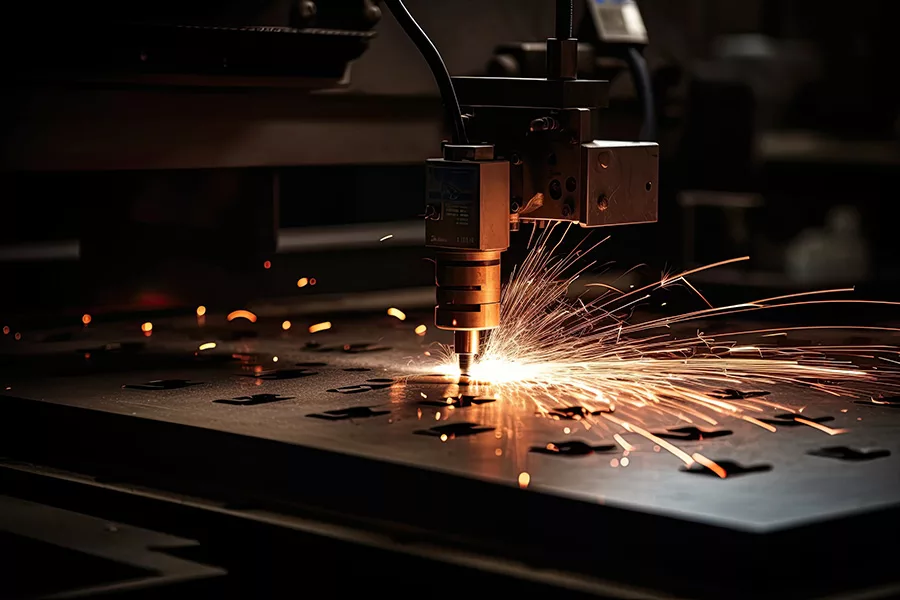
Cutting with nitrogen is fusion cutting. The beam melts the material and the assist gas blows the melt out of the kerf. Oxygen would join in and burn, which is faster and cheaper but leaves an oxide layer on the edge. Nitrogen does not react. The edge comes out bright, ready to paint or weld without a second operation, and the gas flow cools the cut zone, which keeps thin sheet from distorting.
You pay for that in gas. Because the melt is driven out mechanically rather than burned away, fusion cutting needs both volume and pressure. A 6 kW fibre laser running flat out draws somewhere between 40 and 60 Nm³/h. Multiply that by your machine hours and the number stops being a technical detail: on a nitrogen-cutting machine, assist gas is usually the biggest variable cost in the hourly rate.
That is why the interesting question is not which generator has the highest number on its data sheet. It is how much gas your parts really need, at what purity and at what pressure. A PSA generator makes that gas from compressed air by passing it through carbon molecular sieve, which takes up oxygen and moisture far faster than nitrogen, with a second bed regenerating while the first one produces. The PSA nitrogen generator page covers the process, and the carbon molecular sieve article explains why the sieve decides what the machine can reach.
Which nitrogen purity your laser cut actually needs
Purity is where most laser installations are specified too high. The table below gives the grades normally used in practice. Confirm them against your own cutting parameters and edge requirements, because they shift with material, thickness and what happens to the part afterwards.
| Material and edge requirement | Typical grade | Why |
|---|---|---|
| Mild steel cut with nitrogen | 99.9 % | Bright edge without oxide scale |
| Stainless steel, thin gauge | 99.9 % | Standard fusion cutting |
| Stainless steel, visible or weld-ready edge | 99.95 % | Residual oxygen starts to tint the edge |
| Stainless steel, thick sections | 99.95 % and above | Longer dwell in the kerf, more time to react |
| Aluminium | 99.95 % | Oxide film forms readily |
| Precision parts, no rework allowed | 99.999 % | Special case, not the norm |
What happens below those grades is gradual rather than sudden. Residual oxygen reacts with the melt at the kerf wall, and the first thing you see is a straw or blue tint on the cut face. Next comes a thin oxide film that has to come off before painting or welding, which turns a finished edge back into a second operation. On thicker sections the effect grows because the melt stays in the kerf longer and has more time to react.
The practical range for laser cutting therefore sits between 99.9 % and 99.95 %. Grades above that exist for good reasons in other applications, and occasionally here, but they are the exception rather than the specification you should start from.
What higher purity costs you in compressed air
Every NITROBERG® size consumes a defined amount of compressed air per cubic metre of nitrogen it delivers. That ratio, the air factor, is the same across the range and depends only on the purity you set.
| Purity | 97 % | 98 % | 99 % | 99.5 % | 99.9 % | 99.99 % | 99.995 % | 99.999 % |
|---|---|---|---|---|---|---|---|---|
| Air factor | 2.3 | 2.3 | 2.6 | 2.9 | 3.4 | 4.6 | 5.2 | 6.4 |
Put your own numbers into it. A shop that needs 50 Nm³/h of nitrogen draws about 170 Nm³/h of compressed air at 99.9 %. Specify 99.999 % instead and the same 50 Nm³/h needs about 320 Nm³/h. That is close to twice the compressor, twice the electricity and twice the compressor room, for gas quality the cut does not use.
This is the most expensive decision on the whole project, and it gets made on the enquiry form rather than at the machine. It is worth ten minutes with your cutting parameters before anyone quotes hardware.
Getting nitrogen to the nozzle at laser cutting pressure
Cutting pressure at the nozzle runs around 8 to 14 bar on stainless steel. It climbs towards 20 bar on thick sections and high-power fibre machines, and reaches 22 to 30 bar when thick mild steel is cut with nitrogen instead of oxygen.
A PSA stage does not produce that on its own, and no manufacturer’s does. NITROBERG® operates at 10 bar with a compressed air inlet of 7 bar(g). Across the industry, standard PSA and membrane generators end at roughly 14 bar. Everything above that comes from a booster. When a supplier advertises 30 bar at the head, the booster is what delivers it.
The difference is where the booster comes from. Berg builds the generator, and the BERG Group builds the compressors, the air treatment and the high-pressure boosters as well, including the KOMPBERG® nitrogen-rated booster range that reaches 350 bar. Compressor station, treatment, dryer, generator, storage and booster therefore come from one group rather than four suppliers. In practice that means one warranty, one contact and one party that sized the whole chain, instead of four vendors each pointing at the interface next to theirs.
Nitrogen on demand, or from storage?
Before anyone picks a model, this decision sets the size of the whole installation, and it is the one most often skipped.
On demand
The generator produces while the laser cuts. Generator and compressor both have to carry the peak, so both are sized for the busiest moment of the day. This is the sensible route once the laser runs beyond roughly twelve hours a day, or above something in the order of 100,000 Nm³ a year.
From storage
The generator also runs while the laser stands, filling storage that the machine draws from. Peaks come out of the buffer rather than the generator, so both generator and compressor can be noticeably smaller. This suits shops running under roughly twelve hours a day, which is most single-shift operations.
The thresholds are rules of thumb, not guarantees, and they move with how evenly your cutting is spread through the day. What matters is that the question gets asked. Two shops with the same laser and the same annual consumption can end up with quite different installations, and the difference sits in the investment, not in the cut.
How to size a nitrogen generator for your laser
Take your peak flow
From nozzle diameter, cutting pressure and material, per machine. With more than one laser, use realistic simultaneity rather than the sum of all machines. Adding the peaks of every machine is the most common way a system ends up oversized, because two lasers rarely cut thick material at full pressure at the same moment.
Set the purity from the edge requirement
Not from the highest grade available. The table above is the starting point, your own cutting parameters are the confirmation.
Decide on demand or storage
Cutting hours per day decide it, and the decision changes the generator size before any model is chosen.
Check the compressed air
Flow times air factor gives the demand. Quality matters as much as quantity, and it is the part that gets forgotten: oil carry-over and residual moisture shorten the life of the carbon molecular sieve, so an undersized dryer costs more over five years than a slightly undersized compressor. NITROBERG® expects compressed air to ISO 8573-1:2010 Class 1.4.1 at 7 bar(g).
Need sizing for your application?
Send us your consumption profile and operating data. Our engineering team will size the generator and confirm the configuration.
NITROBERG® sizes for laser cutting duty
The sizes below cover the range most laser installations fall into. Nitrogen output is shown at the three grades that matter here, with the compressed air needed at 99.9 %.
| Model | N₂ at 99.9 % | N₂ at 99.99 % | N₂ at 99.999 % | Compressed air at 99.9 % |
|---|---|---|---|---|
| NITROBERG® 1000 | 34.4 Nm³/h | 18.5 Nm³/h | 10.1 Nm³/h | 117.1 Nm³/h |
| NITROBERG® 1100 | 45.1 Nm³/h | 24.2 Nm³/h | 13.2 Nm³/h | 153.3 Nm³/h |
| NITROBERG® 1200 | 55.8 Nm³/h | 29.9 Nm³/h | 16.3 Nm³/h | 189.6 Nm³/h |
| NITROBERG® 1300 | 78.7 Nm³/h | 42.2 Nm³/h | 23.0 Nm³/h | 267.6 Nm³/h |
| NITROBERG® 1400 | 109.9 Nm³/h | 59.0 Nm³/h | 32.2 Nm³/h | 373.6 Nm³/h |
A single 6 kW fibre laser at 40 to 60 Nm³/h lands between the 1100 and the 1200 at 99.9 %. A second machine or thicker material moves you up; running from storage instead of on demand moves you down. The range does not stop there and continues to 1,709.1 Nm³/h for shops with a hall full of machines.
Where there is no suitable compressed air on site, a laser nitrogen generator is planned as a complete plant rather than as a single machine: compressor station, air treatment, buffer, generator, nitrogen storage and the boosting station, engineered as one chain. The nitrogen generation package covers the pre-assembled plug-and-play configurations at the smaller end of the range; above those sizes the same chain is put together as a project. Applicable NITROBERG® pressure equipment is conformity assessed under PED 2014/68/EU within the certified scope. Engineering and manufacturing are Made in Germany.
On-site nitrogen compared with tanks and cylinders
At cutting pressure a single cylinder lasts minutes rather than shifts, which makes cylinders a stopgap for a sample part rather than a supply for production. A liquid nitrogen tank solves that and delivers both purity and peak flow. What it does not solve is that the meter runs whether you cut or not: rental continues through quiet weeks, evaporation losses continue overnight, contracts carry price escalation clauses, and a delivery schedule you do not control decides when the tank is full.
Generating on site swaps all of that for an investment and an electricity bill you can put in the hourly rate. Against liquid-gas supply, a Berg PSA generator typically pays for itself within two to three years.
Purity you configure
The generator is set to the grade your parts need, not the highest one on the data sheet. That single setting decides the size of the compressor behind it, which is where the running cost actually sits.
Standard wear parts
Filters and consumables are off-the-shelf items from the open market. There is no proprietary parts programme after the purchase, and it is worth asking every supplier you compare where their filters come from.
The whole chain from one group
NITROBERG® generator, KOMPBERG® compressors and boosters, air treatment, dryer and storage are all built within the BERG Group. One warranty and one party that sized the chain, rather than four suppliers meeting at an interface.
Direct access to engineering
Sizing questions go to the people who design the machines, not to a call centre. Warranty runs three years as standard and up to five years with a service contract.
FAQ: nitrogen generators for laser cutting
A 6 kW fibre laser cutting at full speed draws roughly 40 to 60 Nm³/h. The figure moves with nozzle diameter, cutting pressure and material rather than with laser power alone, because a larger nozzle passes more gas at the same pressure. Thick mild steel cut with nitrogen at 22 to 30 bar can reach 40 to 120 Nm³/h. For sizing, take the peak flow of each machine, apply a realistic simultaneity factor if you run more than one, and add headroom for the machine you buy next.
In practice, between 99.9 % and 99.95 %. The lower end gives a bright, scale-free edge on thin stainless and on mild steel cut with nitrogen. The upper end is normal where the edge is visible on the finished part, where it goes straight to welding, or on thicker sections and aluminium, because residual oxygen has more time to tint the edge. Grades of 99.999 % exist for precision work that allows no rework at all, but they are a special case, and they roughly double the compressed air needed for the same amount of gas.
The PSA stage itself delivers 10 bar in the case of NITROBERG®, from a compressed air inlet at 7 bar(g). Standard PSA and membrane generators across the industry end at around 14 bar. Cutting pressures above that come from a booster, which is true of every supplier, including those advertising 30 bar at the nozzle. At Berg the booster is built within the BERG Group, where the KOMPBERG® nitrogen-rated range reaches 350 bar, so the generator and the compression stage after it are engineered together rather than bought separately.
Possibly, and the number is easy to check before anyone quotes. Multiply your nitrogen flow by the air factor for the purity you choose: 3.4 at 99.9 %, 6.4 at 99.999 %. Running from storage rather than on demand lowers the figure considerably, because the compressor no longer has to cover the peak. Air quality counts too, not just volume, because the sieve life depends on it. NITROBERG® expects compressed air to ISO 8573-1:2010 Class 1.4.1.
Cutting hours decide it. Beyond roughly twelve hours a day, or above something in the order of 100,000 Nm³ a year, on-demand generation usually makes sense because the buffer would have no quiet period to refill in. Below that, generating into storage lets both the generator and the compressor be smaller, since peaks come out of the buffer. Both figures are rules of thumb and shift with how evenly your cutting is spread through the day.
Cut quality follows purity and pressure at the nozzle, not the source of the gas. A generator set to the grade your parts need, with the pressure supplied at the head, produces the same edge as delivered gas at the same specification. The difference is that purity is a setting you choose and monitor continuously rather than a number on a delivery note, so a drop shows up as an alarm instead of showing up on the part.
No. The wear parts are standard components rather than a proprietary programme, which keeps the running cost open to competition: you can source filters where you want and compare service offers. Over the service life of the machine that usually weighs more than the difference in purchase price. Warranty runs three years as standard and up to five years in combination with a service contract.