Oxygen Generators for Aquaculture: From Feed Rate to Model Size
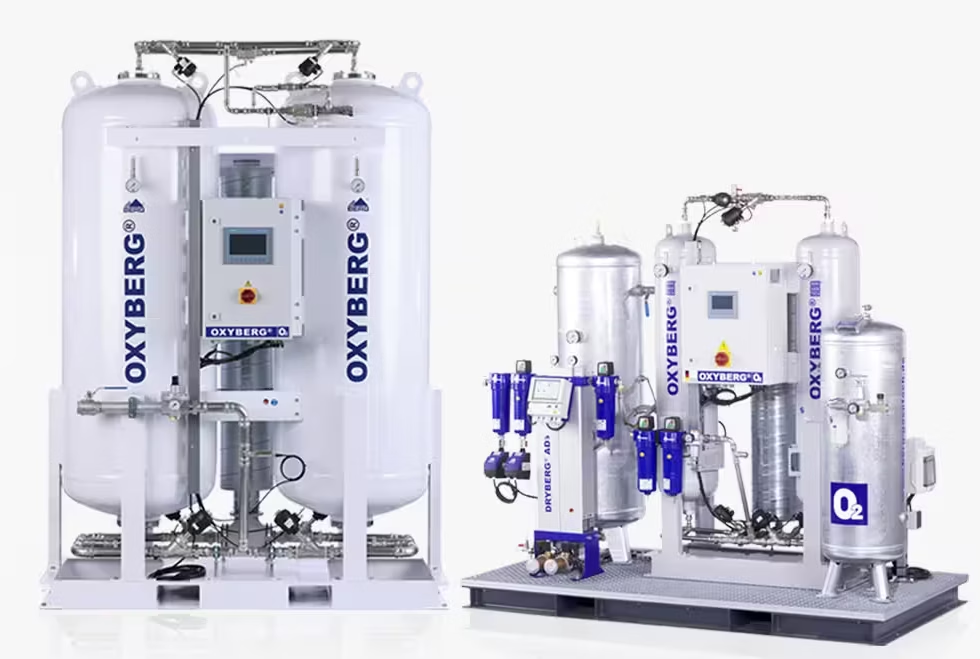
OXYBERG® oxygen generators separate oxygen from compressed air at your own site and feed recirculating and flow-through aquaculture systems. The sizing starts at your daily feed rate, runs through the transfer efficiency of your equipment and ends at a model size. Liquid oxygen is still the better answer in some operations, and the comparison below says which.
Where Aquaculture Oxygen Generators Are Used
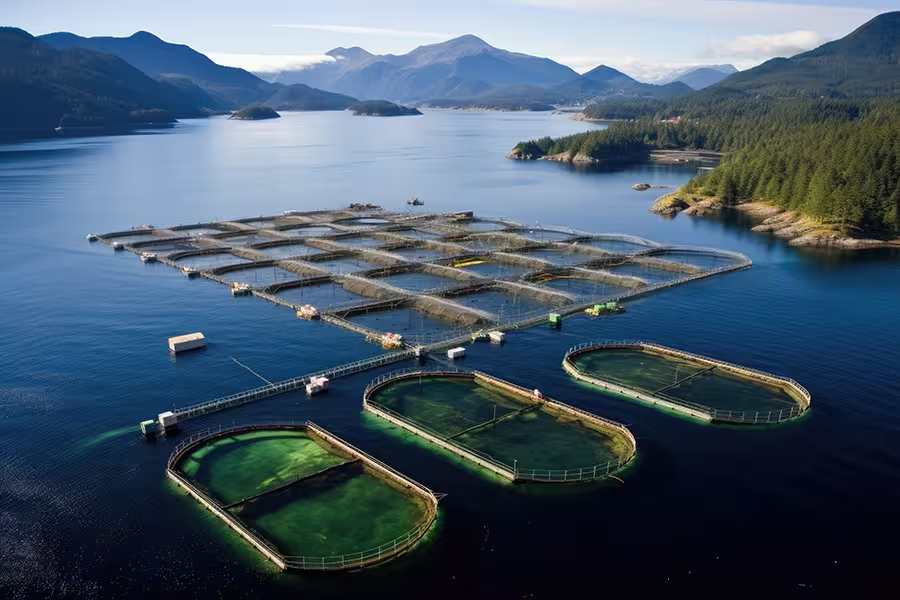
Oxygen is added wherever stock is held at a density that ambient air can no longer support. That covers recirculating systems, flow-through raceways and tanks, the land base of a net-pen site, hatcheries and larval rearing, broodstock holding, grow-out and the working hours around grading, harvesting and live transport. The common factor is not the species and not the tank shape. It is that the stock, the feed and the biofilter draw more oxygen than the water can hold.
Three situations decide the size of the generator. The first is the warmest week of the year. The second is the hour after feeding, when the whole system draws hard at once. The third is steady operation at the top of the stocking density you want to run.
All three tend to arrive together, and that is what makes the sizing case: demand rises at exactly the moment the water can hold less. The numbers behind it are in the next section.
The generator itself is the smaller part of the story. Compressed air passes over a zeolite molecular sieve that holds back nitrogen, two vessels alternate between adsorption and regeneration, and oxygen leaves at the purity you set. The full process description is on the PSA oxygen generator page. The consequence matters more than the process: the generator delivers gas, and everything that decides how much of it ends up dissolved in your water sits between the generator and the tank.
The Dissolved Oxygen Your Stock Needs
What you manage is the dissolved oxygen in the tank, not the purity at the generator. Between the level that keeps fish alive and the level at which they feed and grow well lies a factor of roughly three: for trout, 2.5 mg/l against 8.0 mg/l. The lower end keeps fish alive. The upper end is where the growth rate and the stocking density come from.
The published thresholds differ by species, and the two documented most precisely sit far apart.
| Threshold | Trout | Sea bass |
|---|---|---|
| Mortality rises (resistance point) | 2.5 to 3.0 mg/l | 1.0 to 2.0 mg/l |
| Growth falls off (physiological dependency threshold) | 5.0 to 5.5 mg/l | 3.0 to 4.0 mg/l |
| Full feed intake needs (fingerlings) | 8.0 mg/l | not stated |
Salmonids stop swimming below 2 to 5 ppm, while tilapia and carp still function at 1 to 2 ppm. Shrimp need at least 2 ppm to grow, and 1.2 ppm is the critical lethal range. For acceptable growth the literature puts the target at 5 mg/l or higher depending on species, and in practice warm-water recirculating systems run at 5 to 6 ppm while cold-water systems can be held above 8 ppm.
The ceiling moves the other way. Air can only drive the water to saturation, and saturation falls as the water warms and as salinity rises.
| Condition | Dissolved oxygen at air saturation |
|---|---|
| Fresh water, 0 °C | 14.602 mg/l |
| Fresh water, 20 °C | 9.08 mg/l |
| Fresh water, 30 °C | 7.54 mg/l |
| Fresh water, 40 °C | 6.323 mg/l |
| Fresh water in the salinity series, 0 ‰ | 7.6 mg/l |
| 27 ‰ salinity | 6.8 mg/l |
| Sea water, 35 ‰ | 6.4 mg/l |
Between 0 °C and 30 °C the solubility almost halves. For a fresh-water site the temperature rows are the ones that matter; the salinity series below them applies to marine and brackish sites. Across the salinity series the figures run from 7.6 mg/l in fresh water to 6.8 at 27 ‰ and 6.4 in sea water, so sea water at 35 ‰ holds roughly 16 % less than fresh water of the same temperature. Marine sites and salmon farming therefore run with less headroom than a fresh-water site at the same stocking density. That is why pure oxygen is used at all: more air cannot pass saturation, while oxygen at 90 % raises the partial pressure in the bubble and with it the driving force into the water. The mechanism is set out in more detail for oxygen generators in wastewater treatment.
Read the two tables against each other and the design case appears on its own. Your design case is the warmest week of the year, not the annual average.
From Daily Feed Rate to Oxygen Demand
Your feed rate is the best starting point for sizing, because it is the one figure the operation already records to the kilogram. Feed cost and growth calculations hang on it, so it is accurate, it is current, and nobody has to estimate it. Oxygen demand in Nm³/h is the figure almost no site has, and the two are linked closely enough to bridge.
| System type | Oxygen per kg of feed | What makes the difference |
|---|---|---|
| Non-submerged biofilter with rapid solids separation | from 0.3 kg O₂ per kg of feed | Solids leave the loop before they are oxidised inside it |
| Submerged biofilter with solids retention | up to 1.0 kg O₂ per kg of feed | Solids stay in the system and keep consuming oxygen |
| Rule of thumb for a well-designed system | around 50 % of the feed quantity | Useful before the system detail is known |
These are design figures from the aquaculture literature, not values Berg GaseTech measured on your system, and the spread between the two extremes is a factor of more than three. Which end you sit at is decided by your biofilter and your solids handling, not by the generator.
The peak matters as much as the daily total. Under high load the oxygen supply has to be able to replace the entire oxygen content of the system every 20 to 30 minutes during peak feeding. Airlift systems at a full stocking density of 60 kg/m³ cover only about half of that demand according to the design literature, which is the practical reason pure oxygen enters the picture at the top of the density range rather than at the bottom.
What follows from all of this is a daily average, not a peak value. The peak comes out of your own feeding pattern and your water temperature, and no documented multiplier exists for it. Peak cover and reserve belong in the design of the complete system, with the feed-rate calculation as the starting point.
How Much Oxygen Reaches the Water
The generator supplies gas; what the stock uses is dissolved oxygen. Everything between the two is the transfer device, and it changes the required machine size more than any other decision on this list.
| Transfer method | Absorption efficiency |
|---|---|
| Flat-plate diffuser in the tank | not above 40 % |
| Properly sized oxygen transfer device | above 90 % |
| Downflow bubble contactor | close to 100 % |
| Oxygen cone (Speece cone), manufacturer figures from the patent literature | about 95 to 100 % |
Between 40 % and close to 100 % lies more than a factor of two. Spend badly here and you buy twice the oxygen for the same dissolved result, whatever its source. Against that factor, the difference between 90 % and 95 % purity at the generator is a small term. Oxygen cones and pressurised packed columns are the usual pressure transfer devices, and where little head is available there are low-head systems with cascade plates.
Air does not belong in a pressurised contactor. Atmospheric air must not be blown into a U-tube or a pressurised packed column, because the nitrogen it carries drives supersaturation and causes gas bubble disease. The same risk appears when air is introduced deeper than roughly 1.5 m, where the total gas pressure rises far enough to do the same damage. Pure oxygen has no nitrogen to force into solution, and that is an argument for it that has nothing to do with cost. Tank levels are therefore held below saturation in practice, which also keeps expensive oxygen out of the atmosphere.
Oxygen does not remove CO₂. A pure oxygen system transfers oxygen well and carbon dioxide not at all, so in a recirculating system it needs a CO₂ stripping stage of comparable size alongside it. In flow-through operation the water leaves the system before carbon dioxide accumulates, so the requirement does not arise there. Either way it changes the scope of the project, which is why it belongs in the sizing conversation. Where you have a system builder, the transfer and stripping equipment comes from them and the oxygen source from Berg GaseTech, with the size of the source depending on both. Where you do not, say so: the transfer efficiency is an input to the sizing, and the calculation can be run for several variants before you commit to a transfer device.
Sizing an Aquaculture Oxygen Generator in Four Steps
The demand from the last two sections becomes a model size in four steps. Every intermediate result is one you can recalculate with your own numbers.
Daily feed rate and system type
Multiply your daily feed quantity by the figure for your system type from the table above. The result is kilograms of oxygen per day. That is the total demand of your system, not the part a generator has to cover: whatever your existing aeration already puts in comes off it first. The airlift figure from the section above, about half the demand at full stocking density, gives the order of magnitude; what it is at your density and with your equipment depends on your system. A site running on blowers and air today therefore sizes the generator on the difference, not on the total.
Account for transfer efficiency
Divide that demand by the absorption efficiency of your transfer device. This is what the generator has to deliver, as opposed to what the stock consumes.
Convert to Nm³/h
A normal cubic metre is defined at 0 °C and 1013.25 mbar, where oxygen weighs 1.429 kg per Nm³. Kilograms per day divided by 1.429 and then by 24 gives the hourly figure as a daily average. Treat the result as an indicative figure for a first assessment, not as a specification.
Check compressed air and site
Compressed air demand is eleven times the oxygen volume. Inlet pressure is 7 bar(g), compressed air quality ISO 8573-1:2010 class 1.4.1, ambient temperature +5 °C to +40 °C, sound level 55 to 78 dB(A), operating pressure 10 bar. The full site requirements are listed on the oxygen generator overview.
Worked example, indicative figures only. A fish farm feeding 500 kg per day:
| Step | Result |
|---|---|
| Oxygen demand at 0.3 to 1.0 kg O₂ per kg of feed | 150 to 500 kg O₂ per day |
| Converted at 1.429 kg per Nm³ | 105 to 350 Nm³ per day, or 4.4 to 14.6 Nm³/h as a daily average |
| Generator output needed at 90 % transfer efficiency | 4.9 to 16.2 Nm³/h, between OXYBERG® 700 and OXYBERG® 1200 |
| Generator output needed with flat-plate diffusers at 40 % | 10.9 to 36.4 Nm³/h, OXYBERG® 1100 to 1500 for the same site |
The same site, the same stock and the same feed, and the transfer device alone moves the machine by several sizes. That is the calculation worth doing before anything else.
The example assumes no existing aeration, so the generator carries the whole demand. If blowers or an airlift already put oxygen into your system, subtract that share after step 1 and the model size comes out correspondingly smaller. For a price-sensitive operation, buying oversized is the most expensive mistake available.
These are daily averages derived from published design figures and the OXYBERG® data sheet. They are not a quotation and not a peak value. The peak, the control concept and the reserve strategy are settled in the design of the complete system.
We Size the Generator From Your Feed Rate
Send your daily feed rate, water temperature range and system type. Name your transfer device if one is installed, or say that you run on blowers and air today. Engineering comes back with a sizing.
OXYBERG® Oxygen Generators for RAS and Flow-Through Systems
Take the Nm³/h figure from step 3 and read it against the range. The table shows the steps of the series at the three purities most often specified in aquaculture, with the compressed air demand at 90 %.
| Model | O₂ at 90 % | O₂ at 93 % | O₂ at 95 % | Compressed air at 90 % |
|---|---|---|---|---|
| OXYBERG® 500 | 2.1 Nm³/h | 1.7 Nm³/h | 1.5 Nm³/h | 23.1 Nm³/h |
| OXYBERG® 700 | 4.9 Nm³/h | 4.2 Nm³/h | 3.8 Nm³/h | 53.9 Nm³/h |
| OXYBERG® 900 | 9.2 Nm³/h | 8.2 Nm³/h | 7.3 Nm³/h | 101.2 Nm³/h |
| OXYBERG® 1100 | 13.8 Nm³/h | 12.8 Nm³/h | 12.1 Nm³/h | 151.8 Nm³/h |
| OXYBERG® 1200 | 18.9 Nm³/h | 17.4 Nm³/h | 15.9 Nm³/h | 207.9 Nm³/h |
| OXYBERG® 1400 | 33.8 Nm³/h | 31.4 Nm³/h | 28.8 Nm³/h | 371.8 Nm³/h |
| OXYBERG® 1500 | 44.6 Nm³/h | 41.6 Nm³/h | 39.1 Nm³/h | 490.6 Nm³/h |
| OXYBERG® 1700 | 65.8 Nm³/h | 62.1 Nm³/h | 59.8 Nm³/h | 723.8 Nm³/h |
| OXYBERG® 2000 | 131.6 Nm³/h | 124.2 Nm³/h | 119.6 Nm³/h | 1,447.6 Nm³/h |
| OXYBERG® 4000 | 197.4 Nm³/h | 186.3 Nm³/h | 179.4 Nm³/h | 2,171.4 Nm³/h |
The range covers 18 model sizes from 500 to 4000. The table shows a selection of them; further sizes sit between the rows shown, and their figures come with the sizing.
In aquaculture the lower end of the purity band is usually the better choice, and that runs against the instinct to order more. The water does not distinguish between 90 % and 95 %, because the partial pressure is far above that of air in both cases. What does change is the yield from the same machine: an OXYBERG® 500 delivers 2.1 Nm³/h at 90 % against 1.5 Nm³/h at 95 %, which is 40 % more, and an OXYBERG® 1500 delivers 44.6 against 39.1 Nm³/h, which is 14 % more. Higher purity costs output here, not compressed air. Smaller sites can take the same generator as a ready-built plant.
Liquid Oxygen or Your Own Generator
For most sites the question is not whether to use gas. It is whether the gas arrives by tanker or is made on site. Both answers are defensible, and which one is cheaper depends on your own load profile rather than on a general argument.
| Liquid oxygen from tank delivery | Your own PSA generator | |
|---|---|---|
| Purity | Up to 99.9 %, one of the purest sources available | 90 % to 95 % across the OXYBERG® range, and above 90 % the water sees no difference |
| Electrical power | None; the tank needs no power | Required, with the compressor as the main consumer |
| Control | Regulates entirely on the vessel’s own pressure | Generator control with an oxygen receiver |
| Maintenance | Practically maintenance free, set and forget | Scheduled service, with wear parts as standard items from the open market |
| Dependence on delivery dates | The refill schedule belongs to the supplier | No refill schedule |
| Strongly seasonal demand | Often the more economical choice | A machine sized for the summer stands oversized the rest of the year |
| Storage on site | A larger quantity of pure oxygen held in store, a fire load to consider when siting the tank | Generated close to the point of demand, less gas held in store |
| Cost over the years | Driven largely by the distance to the nearest supplying plant | Typical payback of two to three years, calculated against a continuous liquid oxygen supply |
| Backup capability | Can support a generator automatically during a power failure or a loss of output | Reserve strategy defined with the complete system design |
The case for the tank is real and worth stating plainly. It needs no electrical supply, it regulates itself, and it is as close to maintenance free as a gas supply gets. In strongly seasonal operation it is frequently the cheaper answer, because summer consumption can run at more than twice the winter figure and a machine built for that peak is idle capacity for the rest of the year.
What the tank cannot fix is distance. Liquefaction is expensive to begin with, and the economics of a delivered supply are determined in large part by how far the site sits from the nearest industrial source, a figure no operator can influence. Refills run on a schedule that belongs to the supplier, prices are revised annually without much negotiating leverage, and long tank contracts are hard to exit.
The generator has an honest drawback of its own. PSA compresses to roughly 7 to 8 bar, while vacuum swing adsorption (VSA) works at a much lower pressure and needs less electricity for the same quantity of oxygen. Berg builds PSA, so that difference is worth knowing before you compare running costs. Against it stand a payback of two to three years, wear parts you can buy anywhere, and delivery dates nobody else sets.
That payback span applies to sites that buy their oxygen as a continuous bulk liquid oxygen supply today. If you run on blowers and air and only buy in during the warm weeks, a generator does not replace an annual invoice, it replaces the top-up. The payback then follows from that purchased quantity alone and comes out differently, usually later. Work it out with what you actually bought over the last two summers rather than with the span above.
As a decision rule: steady daily demand favours generating your own, strongly seasonal demand favours the tank, and a combination of the two is the normal case rather than a contradiction. In the combined case the generator covers the base load that runs all year and the existing tank covers the seasonal peak. The generator is then sized on the quantity you need the whole year round rather than on the warmest week, the bought-in volume shrinks to the peaks, and the same tank supports the generator automatically during a power failure or a loss of output. Which split pays depends on your purchased quantity and on what your supplier charges at a smaller offtake. The same economics seen from the other side are set out under when a rented tank stops being the cheaper answer.
Oxygen for Hatcheries and Broodstock
In hatcheries, egg incubation and broodstock holding the quantities are small and the demand runs evenly, which is a different sizing case from grow-out. The smallest size in the range delivers 2.1 Nm³/h at 90 %, and plug-and-play configurations exist for OXYBERG® 500 to 900, so a small site does not need a project to get a working oxygen supply. Above model size 900 the plant is sized for your site, and the division of labour stays the same: you bring the feed rate, the temperature range and the system type, engineering brings the model size, the air demand and the site requirements.
What counts in this part of the operation is a steady setpoint rather than a high one. Early life stages are the stock most sensitive to supersaturation, so the limits described above under transfer apply here with the least margin for error.
Grading and sampling are planned load peaks in every hatchery calendar. They are short, they are scheduled, and they need oxygen available on the day rather than on a delivery date. That is also the ground on which the organic rules are written, which is the subject of the next section.
Oxygen Under the EU Organic Rules for Aquaculture
Certified organic aquaculture in the EU restricts oxygen use sharply, and this is worth checking before an investment rather than after. Regulation (EU) 2018/848, Annex II, Part III, point 3.1.6.5 says oxygen “may only be used for uses linked to animal health and welfare requirements and for critical periods of production or transport”, and then only in three cases: “(a) exceptional cases of a change in temperature, a drop in atmospheric pressure or accidental water pollution; (b) occasional stock management procedures, such as sampling and sorting; (c) in order to assure the survival of the farm stock.” Point 3.1.6.4 of the same annex permits aeration for animal welfare and health, and adds that mechanical aerators “shall be preferably powered by renewable energy sources”.
The practical consequence is clear. In a certified organic operation, continuous oxygen dosing to lift stocking density is not an available option.
The three permitted cases do point somewhere, though. A temperature event, a grading or sampling day, and a situation where the stock has to be kept alive all share one property: the oxygen has to be there at short notice. Short notice is where on-site generation is structurally better suited than a delivery with a delivery date, and that, not stocking density, is the organic argument for making your own.
Who Builds the Generator and Who Keeps It Running
Aquaculture sites are rarely close to anything. Who turns up when the plant stops is therefore a bigger part of this decision than it would be on an industrial estate.
Made in Germany
The generator is engineered and manufactured in Germany, at a price level that holds up internationally. The company that developed it is the company that answers the phone about it, on +49 2151 568 9550.
Standard spare parts
Sieve material, valves and filters are off-the-shelf items you can buy on the open market. A hatchery or grow-out site keeps its oxygen supply for decades, and over that time standard parts are the difference between a service budget you control and one your supplier sets.
Worldwide service
You reach a local service contact in most markets, with a direct line to the German headquarters. The distance that makes delivered liquid oxygen expensive is the same distance service has to cover, which is why the network decides more on a remote site than on an industrial estate.
Warranty and engineering access
The warranty runs three years, and five with a service contract. You supply the feed rate, the temperature range and the system type, engineering supplies the model size, and you talk to engineers rather than a call centre.
Also available under your own brand
Units ship with your RAL colour, logo, manual and HMI.
FAQ: Aquaculture Oxygen Generators
90 % is normally sufficient and usually the better buy. The water responds to the partial pressure of oxygen in the bubble, and at both 90 % and 95 % that is far above the partial pressure in air, so the dissolved result is effectively the same. What differs is the yield from the same machine, and the model table above puts a number on it for every size. Because the compressed air factor of 11 does not change with purity, a higher purity costs you output rather than air.
A liquid oxygen supply can support a generator automatically during a power failure or a loss of output, which is one reason the two supply models are often combined rather than chosen between. On-site oxygen generation can significantly reduce dependence on external cylinder or liquid-oxygen deliveries. The required reserve and backup oxygen strategy must be defined according to the complete system design, applicable standards and local regulations. In aquaculture that conversation belongs at the start of the project rather than at the end.
In a recirculating system, yes. The published design guidance is a carbon dioxide stripping stage of comparable size alongside the oxygen system, and the section on transfer above has the reasoning. In flow-through operation the water leaves the system before carbon dioxide accumulates, so the requirement is different. Either way it is a scope question rather than a generator question, which is why a sizing conversation covers your loop and not only your gas demand.
Yes, and the mechanism is total gas pressure rather than oxygen itself. Supersaturation causes gas bubble disease, and the nitrogen in atmospheric air is what forces the total gas pressure up, which is why air has no place in a pressure transfer device. The section on transfer above sets out the depth and equipment limits. Early life stages in a hatchery have the least margin, so a steady setpoint below saturation matters more there than a high one.
Compressed air demand is eleven times the oxygen volume, and the factor is the same at every purity in the OXYBERG® band, so the calculation is straightforward: take the Nm³/h figure the generator has to deliver and multiply by 11. Inlet pressure is 7 bar(g) and the air has to meet ISO 8573-1:2010 class 1.4.1, which is a requirement on the compressed air you supply rather than a property of the generator. With a single unit you supply that air yourself, so the compressor is a separate investment and the main electrical consumer. For OXYBERG® 500 to 900 the plug-and-play configuration already includes air generation and treatment. The full site requirements are listed on the oxygen generator overview.
By duty, by documentation and by conformity. An industrial generator is designed for continuous duty, and purity is measured continuously by a zirconium analyser with the reading shown at the HMI, long-term logging and time-stamped alarms with an audit trail, so you can show what the gas was doing last Tuesday night. Applicable OXYBERG® standard generator assemblies are conformity assessed under PED 2014/68/EU using Modules B and D. A concentrator built for a different purpose offers none of that, whatever its stated flow.
Only in the three cases the regulation names. Regulation (EU) 2018/848, Annex II, Part III, point 3.1.6.5 allows oxygen for animal health and welfare and for critical periods of production or transport; the official wording of all three cases is quoted in the section on the organic rules above. Continuous dosing to raise stocking density is not among them. All three are short-notice events, and that is where generating on site has the structural advantage.
Yes. Plug-and-play configurations are available for OXYBERG® 500 to 900, covering 2.1 to 9.2 Nm³/h at 90 % purity. They arrive as an assembled package rather than as components to be engineered on site, which suits a hatchery or a smaller grow-out operation with no in-house technical department, and they bring their own air generation and treatment. Above model size 900 the plant is sized for your site; you still bring the feed rate, the temperature range and the system type, and engineering brings the rest. The complete oxygen plant page shows what is included.