
Nitrogen and oxygen are essential gases for many industrial processes, from food packaging and chemical production to wastewater treatment, aquaculture and metal processing. Traditionally, these gases are supplied in cylinders or delivered as liquid gas. For facilities with regular demand, however, producing gas on site can offer a more controlled and flexible approach.
On-site gas generation uses compressed air as the feed source and produces nitrogen or oxygen directly at the facility. This can reduce dependence on external deliveries while giving operators greater control over supply, purity, pressure and planning.
The right solution depends on the application. Before selecting a system, it is important to understand which gas is needed, how much is required and how the facility operates.
Why Consider On-Site Gas Generation?
On-site production is more than an alternative to cylinders or storage tanks. It makes gas supply part of the facility’s own utility infrastructure.
Greater Control Over Supply
External gas supply depends on deliveries, storage and supplier availability. On-site generation produces gas directly where it is needed, which can be valuable when interruptions could affect production or process stability.
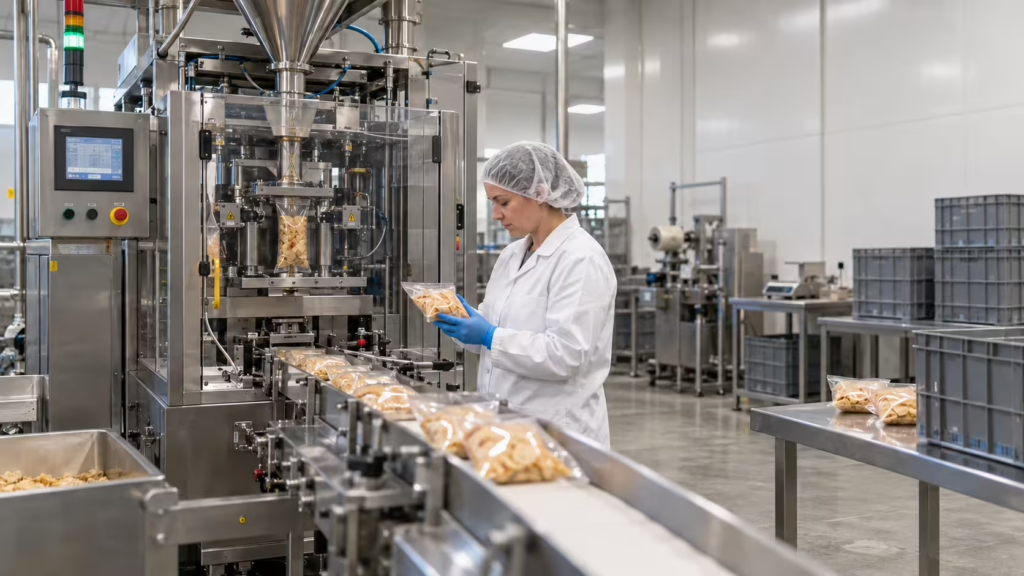
Nitrogen generators are dependable, simple to operate and supply nitrogen continuously on demand, which makes them a reliable part of the utility infrastructure in food packaging.
Production at the Point of Use
Producing gas at the facility can reduce the need to transport and store large quantities of nitrogen or oxygen. For plants with suitable space and compressed-air infrastructure, this can simplify day-to-day gas management.
A Supply Matched to the Application
Different processes require different gas purity, flow and pressure. The most efficient solution is therefore not necessarily the one with the highest specification. Gas quality and capacity should be matched to the actual process requirement.
Less Dependence on Gas Logistics
For facilities with regular consumption, on-site production can reduce reliance on cylinder changes or bulk-gas deliveries and make supply planning more predictable.
Nitrogen or Oxygen: Which Gas Does Your Process Need?
Nitrogen and oxygen may both be obtained from compressed air, but they perform very different functions.
Nitrogen Applications
Nitrogen is commonly used where an inert or controlled atmosphere is required. Typical applications include food packaging, tank blanketing, purging, chemical and pharmaceutical processes, electronics, laser cutting and plastics.
For food packaging, see BERG’s nitrogen generation solutions for food packaging.
Oxygen Applications
Oxygen is used where increased oxygen availability supports a biological, chemical or combustion-related process. Common applications include aquaculture, wastewater treatment, biogas, ozone generation, metal processing, glass production and medical oxygen supply.
For an overview of BERG’s oxygen equipment, see on-site oxygen generators.
The required gas purity, flow and pressure can vary significantly between applications, so system selection should always begin with the process.
Delivered Gas vs. On-Site Gas Generation
Both supply methods can be appropriate. The better choice depends on consumption, infrastructure, logistics and operating requirements.
[Insert comparison table: Delivered Gas vs. On-Site Gas Generation]
Facilities with very low or irregular consumption may find delivered gas practical. For regular and predictable demand, on-site generation can provide greater control and reduce dependence on delivery schedules.
The comparison should consider the complete supply strategy rather than the gas purchase price alone.
What Makes On-Site Gas Generation Efficient?
Match Purity to the Application
The required gas purity should be defined by the process. Selecting a higher specification than necessary can increase system requirements without providing a useful process benefit.
Match Flow to Actual Demand
Average consumption is only part of the picture. Peak demand, simultaneous users and production changes should also be considered when determining the required capacity.
Consider the Operating Profile
Operating hours and production schedules influence system requirements. A continuously operating plant may need a different solution from a facility running only one or two shifts.
Check the Existing Infrastructure
Compressed-air capacity, air treatment, electrical supply, installation space and gas distribution should all be considered before selecting the generation equipment.
An efficient system is not simply the largest generator or the highest-purity option. It is a system that matches the process.
What Should You Consider Before Choosing a Gas Generator?
Before comparing individual models, define the basic requirements of the application:
- Gas type – nitrogen or oxygen
- Required purity
- Average gas flow
- Peak gas flow
- Required outlet pressure
- Operating hours and shifts
- Available compressed-air capacity
- Installation space and conditions
- Continuity or redundancy requirements
- Expected future demand
This information provides a much stronger basis for system selection than starting with a specific generator model.
For an overview of BERG’s nitrogen equipment, see the NITROBERG® nitrogen generator range. For oxygen applications, see the OXYBERG® oxygen generator range.
Standalone Generator or Complete Gas Generation System?
The right system architecture depends largely on the infrastructure already available at the site.
Standalone Gas Generator
A standalone generator can be integrated into an existing compressed-air system when suitable utilities are already available.
Integrated Gas Generation System
Where supporting utilities are not available, the solution may also require air compression, air treatment, storage and control equipment.
Skid-Mounted Plant
For projects where simplified installation is a priority, a pre-assembled skid can combine the main components into one engineered system.
For nitrogen applications, BERG offers complete nitrogen generation packages for integrated installations.
How Does PSA Fit Into On-Site Gas Generation?
Pressure Swing Adsorption (PSA) is an established technology for producing nitrogen and oxygen from compressed air.
At a high level, PSA uses a selective adsorbent to separate components of compressed air. Controlled pressure and regeneration cycles allow the required gas to be produced continuously on site.
The detailed technology differs between nitrogen and oxygen generation. For more technical information, see PSA nitrogen generation and PSA oxygen generation.
Where Is On-Site Gas Generation Used?
Nitrogen generation is commonly used in food and beverage production, pharmaceuticals, chemicals, electronics, laser cutting, packaging and inerting processes.
Oxygen generation is used in applications such as aquaculture, wastewater treatment, biogas, ozone generation, metal and steel processing, glass production and medical oxygen supply.
Although the same basic on-site concept can serve many industries, the required purity, flow and pressure change with the application.
When Does On-Site Gas Generation Make Sense?
On-site generation is particularly worth evaluating when a facility has regular gas consumption, predictable production demand or a significant dependence on external deliveries.
It can also be attractive where gas storage and delivery logistics are becoming difficult to manage or where consistent gas availability is important.
However, on-site generation is not automatically the best option for every facility. Low, occasional or highly unpredictable consumption may still favour delivered gas.
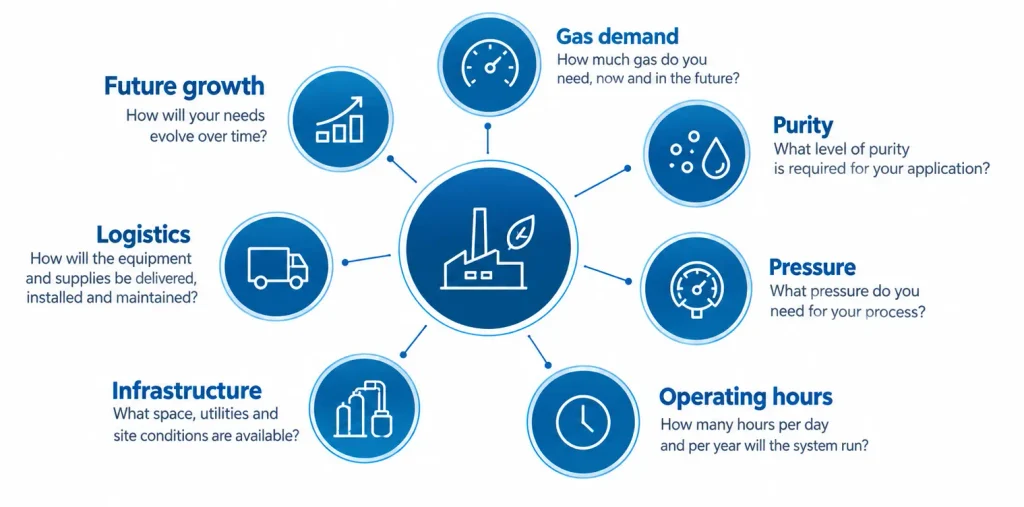
The decision should be based on the complete operating picture:
A Practical Decision Framework
Before investing in an on-site nitrogen or oxygen system, answer five basic questions:
- What gas do we need? Identify whether the process requires nitrogen or oxygen and define its role.
- What quality is required? Determine the purity and pressure needed at the point of use.
- How much gas do we consume? Establish both average and peak demand.
- What infrastructure is already available? Check compressed-air capacity, air treatment, electrical supply, installation space and gas distribution.
- How may demand change? Consider future production growth, additional equipment and changing operating schedules.
Frequently Asked Questions
No. Both can use compressed air as the feed source, but different separation configurations are used to produce nitrogen or oxygen.
No. Suitability depends on consumption, operating hours, purity, pressure, infrastructure and supply requirements.
No. Purity should be matched to the application. A higher specification than necessary can increase system and operating requirements.
It depends on the installation. Where suitable compressed air already exists, a standalone generator may be sufficient. Otherwise, compression and air treatment can be included in the system.
The key information includes gas type, purity, average and peak flow, pressure, operating hours, available compressed air and installation conditions.
Choose a Gas Supply Strategy That Fits Your Process
Nitrogen and oxygen generators provide an alternative to traditional gas supply methods by producing gas directly where it is needed.
The right solution is not simply the largest generator or the highest purity available. It is the system that matches the process, demand profile and existing infrastructure.
For regular and predictable gas demand, on-site generation can provide greater control over supply while reducing dependence on external gas logistics.
Start with the process, then design the gas supply around it.
Discuss Your Gas Generation Requirements
For help evaluating nitrogen or oxygen generation for your application, Contact BERG GaseTech and discuss your requirements with the engineering team.