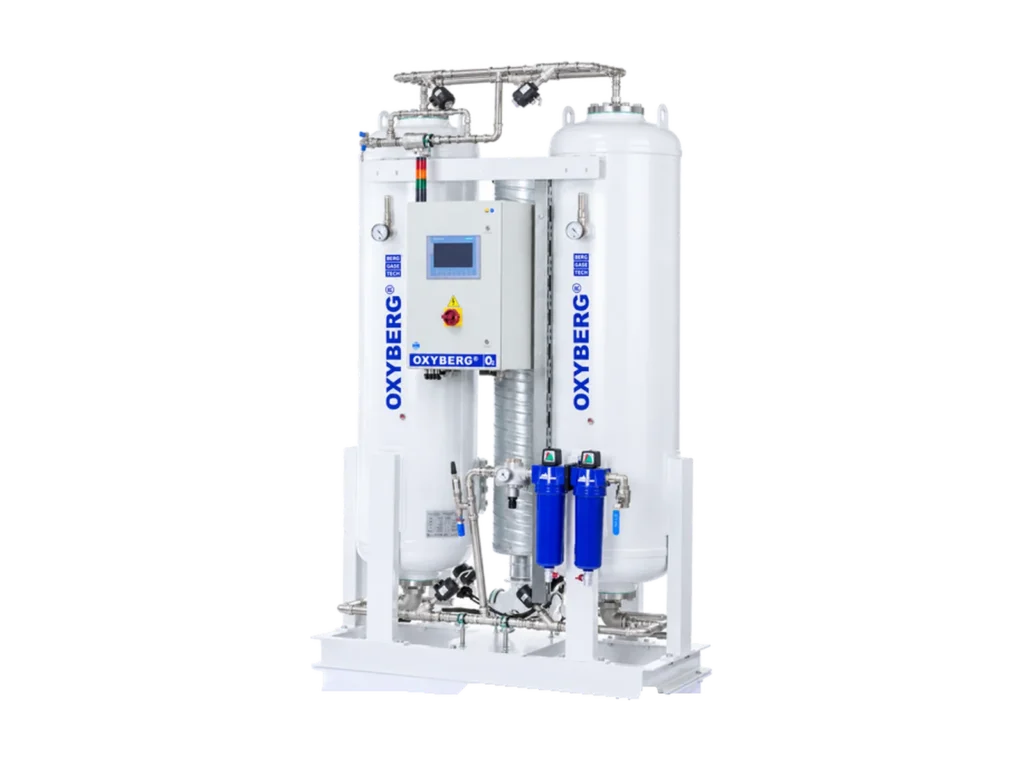
A PSA oxygen generator turns ordinary compressed air into oxygen: a bed of zeolite holds the nitrogen back and lets the oxygen through at 90 % to 95 % purity. The process behind it is called pressure swing adsorption, which is where the PSA in the name comes from. This article explains how it works and why the purity stops at 95 %. It also covers how much of the oxygen in the intake air reaches the product and which figures you need before you ask anyone for a quote.
What Is a PSA Oxygen Generator?
A PSA oxygen generator is a machine that produces oxygen on site from compressed air, at a purity between 90 % and 95 % and at a pressure of several bar. It needs compressed air, electricity and floor space. It does not need a delivery schedule, a liquid oxygen tank or a supply contract.
That last point is usually the reason operators look at the technology in the first place. The alternative to generating oxygen is buying it, as liquid oxygen in a tank or as cylinders, and both come with annual price adjustments, long contract terms and a dependence on someone else’s logistics. A generator replaces that running cost with a one-off investment, the electricity to run a compressor and the upkeep the installation needs. Where exactly the two models cross over depends on your consumption, your electricity price and your current gas contract, and we have put the numbers for that comparison into a separate article on oxygen generator costs.
What Pressure Swing Adsorption (PSA) Means
The name of the process describes it exactly, and its three words give the abbreviation.
Pressure, the P. The separation is driven by pressure, not by cold and not by a chemical reaction. That one word sets the process apart from both alternatives. Cryogenic air separation liquefies the air and then distils it, which takes a plant of a completely different size. Chemical oxygen generation releases oxygen from a compound that is consumed in the process, as in an aircraft emergency supply, where a sodium chlorate charge decomposes once and is spent. Pressure swing adsorption does neither. It works at room temperature with a material that behaves differently under high and low pressure.
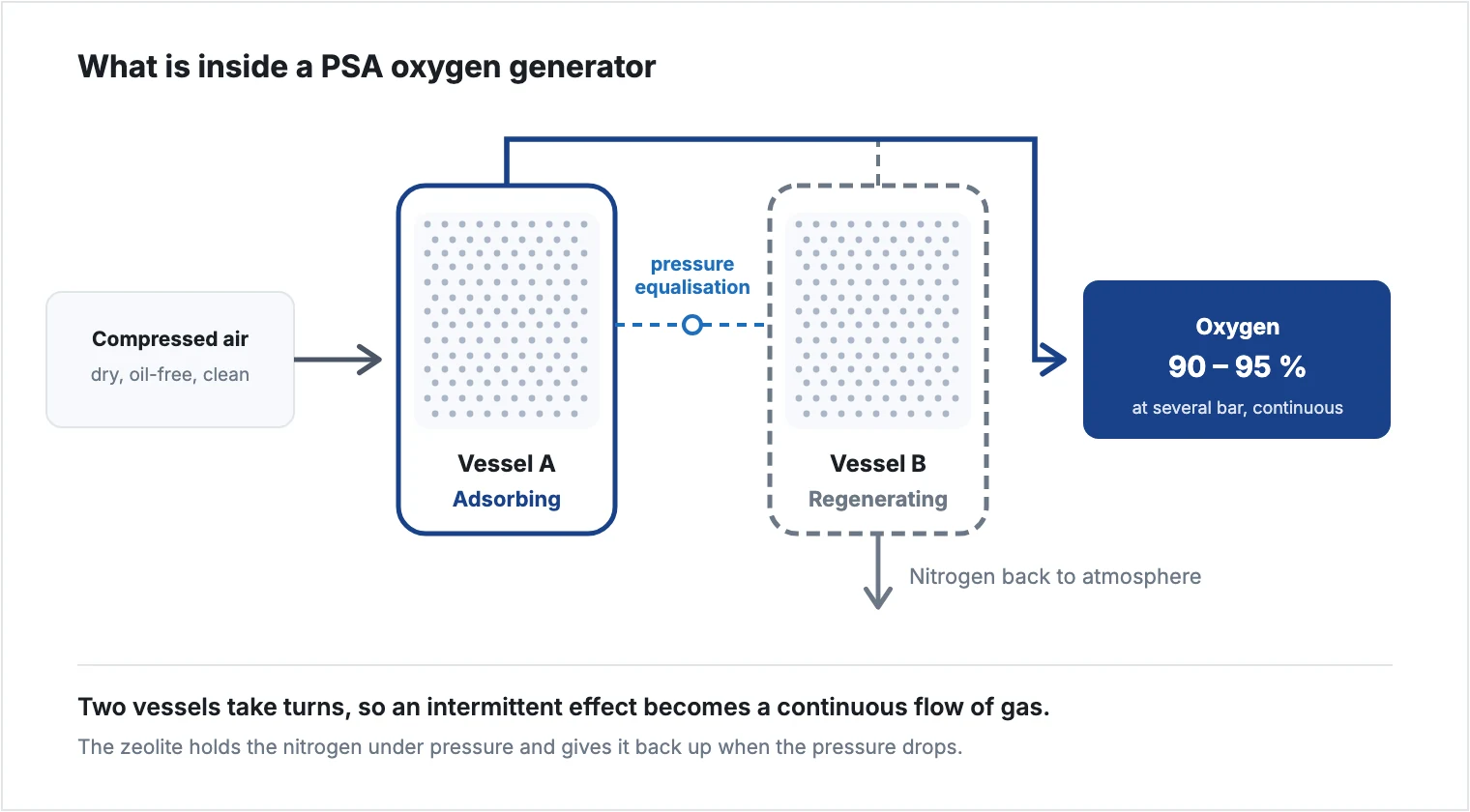
Swing, the S. The pressure changes rather than staying constant. Under pressure, the zeolite takes up nitrogen; when the pressure drops, it gives the nitrogen back up. One vessel alone could therefore only work in bursts, which is why an industrial PSA oxygen generator is built with two of them. While one is adsorbing, the other is being regenerated, and the swing between the two states is what turns an intermittent effect into a continuous flow of gas.
Adsorption, the A. The third word is the one most often misread.
Adsorption Is Not Absorption
Adsorption means the gas molecules attach to the surface of the zeolite rather than entering the material itself. If they soaked into it, that would be absorption with a b, a different process with different consequences. Because the nitrogen only sits on the surface, dropping the pressure is enough to release it, without heat and without a chemical step. The sieve is therefore regenerated in every single cycle rather than consumed, which is the reason a molecular sieve is not a consumable the way a filter cartridge is.
How Zeolite Separates Oxygen from Nitrogen
The molecular sieve in an oxygen generator is a zeolite that binds nitrogen far more strongly than oxygen, so the gas that passes through the bed is the product. Two types are in use. 13X, a sodium zeolite, is the established fill for industrial oxygen generation. We fill our own generators with ZEO 13X zeolite molecular sieve from a German manufacturer. Lithium-exchanged LSX binds more nitrogen per litre of bed and costs more per litre, which is why it sits where space is tight or the purity has to be held at the top of the range, as in medical concentrators.
What makes this work is a difference in equilibrium. The nitrogen molecule carries a quadrupole moment nearly four times that of oxygen, and that is what the charged sites inside the zeolite structure hold on to. Feed compressed air into the bed and the nitrogen stays behind while the oxygen moves through and leaves at the outlet. The engineering term for this is equilibrium separation, and it is the reason the product gas of an oxygen generator is the stream that was not adsorbed.
Nitrogen generators look similar from the outside and work on a different principle entirely. They use carbon molecular sieve, where oxygen and nitrogen are held with roughly comparable strength. There, the separation depends on rate: oxygen reaches the micropores faster than nitrogen does, so with a short enough cycle, the oxygen is captured and the nitrogen passes through. That is kinetic separation, and the product is again the stream that was not adsorbed, which in this case is nitrogen.
The distinction matters more than it may appear, because it governs what limits each machine. In oxygen generation, the ceiling is set by argon, which behaves almost exactly like oxygen on zeolite. In nitrogen generation, there is no comparable physical ceiling; purity is traded against cycle time and yield, which is why nitrogen generators reach 99.999 % and oxygen generators do not. The two adsorbents are described in more detail in our articles on zeolite and carbon molecular sieve.
Why You Cannot Convert a Nitrogen Generator to Oxygen
Equilibrium separation on zeolite and kinetic separation on carbon molecular sieve are different physical effects, so the two machines are not the same machine with a different adsorbent.
| Oxygen PSA | Nitrogen PSA | |
|---|---|---|
| Adsorbent | Zeolite, 13X or lithium-exchanged LSX | Carbon molecular sieve |
| Mechanism | Equilibrium separation: nitrogen is bound far more strongly | Kinetic separation: oxygen diffuses into the pores faster |
| Product | The stream that is not adsorbed: oxygen | The stream that is not adsorbed: nitrogen |
| Purity limit | Argon, which behaves like oxygen | Cycle time and yield, no hard physical ceiling |
Swapping the adsorbent would also mean changing cycle times, vessel sizing, valve timing and the control logic that holds all of it together. If you operate a nitrogen PSA today and need oxygen as well, you need a second machine, not a conversion.
How the PSA Cycle Works
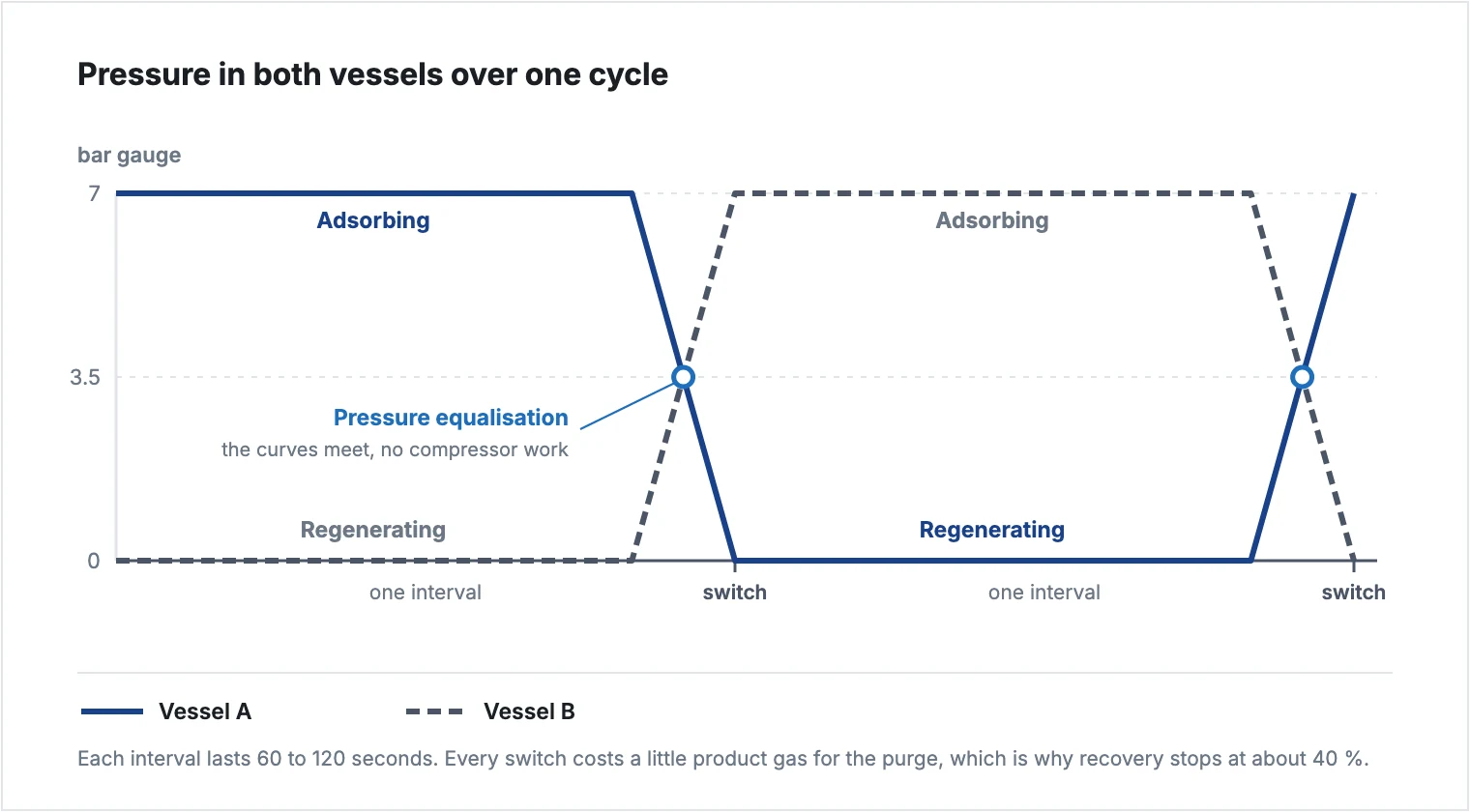
Two zeolite beds take turns: while one adsorbs nitrogen under pressure, the other releases it at ambient pressure, and the constant switching keeps the oxygen flow continuous. Our own generators run at 7 bar gauge as standard, with one switch every 60 to 120 seconds, and that is the point every performance figure we publish refers to. Inlet pressure and bed pressure are the same number here, because the air enters the vessel at the pressure the separation runs on. Published figures for the industry put the common range at 4 to 7 bar with switching from 30 seconds, so the two agree on the order of magnitude. Where you see 10 bar quoted, that is the maximum allowable pressure (PS) of the vessels under the Pressure Equipment Directive, not the pressure the bed works at day to day.
The sequence starts when compressed air enters the first vessel. Nitrogen attaches to the zeolite, oxygen passes through, and most of the product gas goes to the point of use, and the remainder is held back for the purge later in the cycle. As the bed fills up with nitrogen, the quality of the outgoing gas would begin to drop, and the control system switches before that happens.
Before the loaded vessel is vented, the two vessels are briefly connected. The pressurised gas in the first flows into the second and raises its pressure without the compressor doing any work for it. This pressure equalisation step puts compression work that is already in the gas back into the process instead of blowing it off, and it is one of the reasons a two-vessel design is more efficient than simply venting a full bed to atmosphere. How much it saves depends on the cycle and the vessel sizing, so there is no catalogue percentage for it, but it is the single step that separates a modern cycle from the original one.
Only then is the first vessel brought down to ambient pressure. The nitrogen lets go of the zeolite and leaves the machine, and a small flow of product oxygen is passed back through the bed as a counter-current purge to push the last of it out. This purge costs product gas, and together with the oxygen that leaves the vessel when it is depressurised, it is why a PSA generator does not deliver all the oxygen that enters it. The bed is then clean, repressurised and ready for the next half of the cycle, which is already running in the other vessel.
The principle goes back to two patents from the late 1950s. Skarstrom’s design regenerates the bed by purging at low pressure; the design of Guerin de Montgareuil and Domine regenerates it under vacuum. Both families are still in use today, as PSA and as VSA or VPSA.
Why Oxygen Purity Stops at 95 %
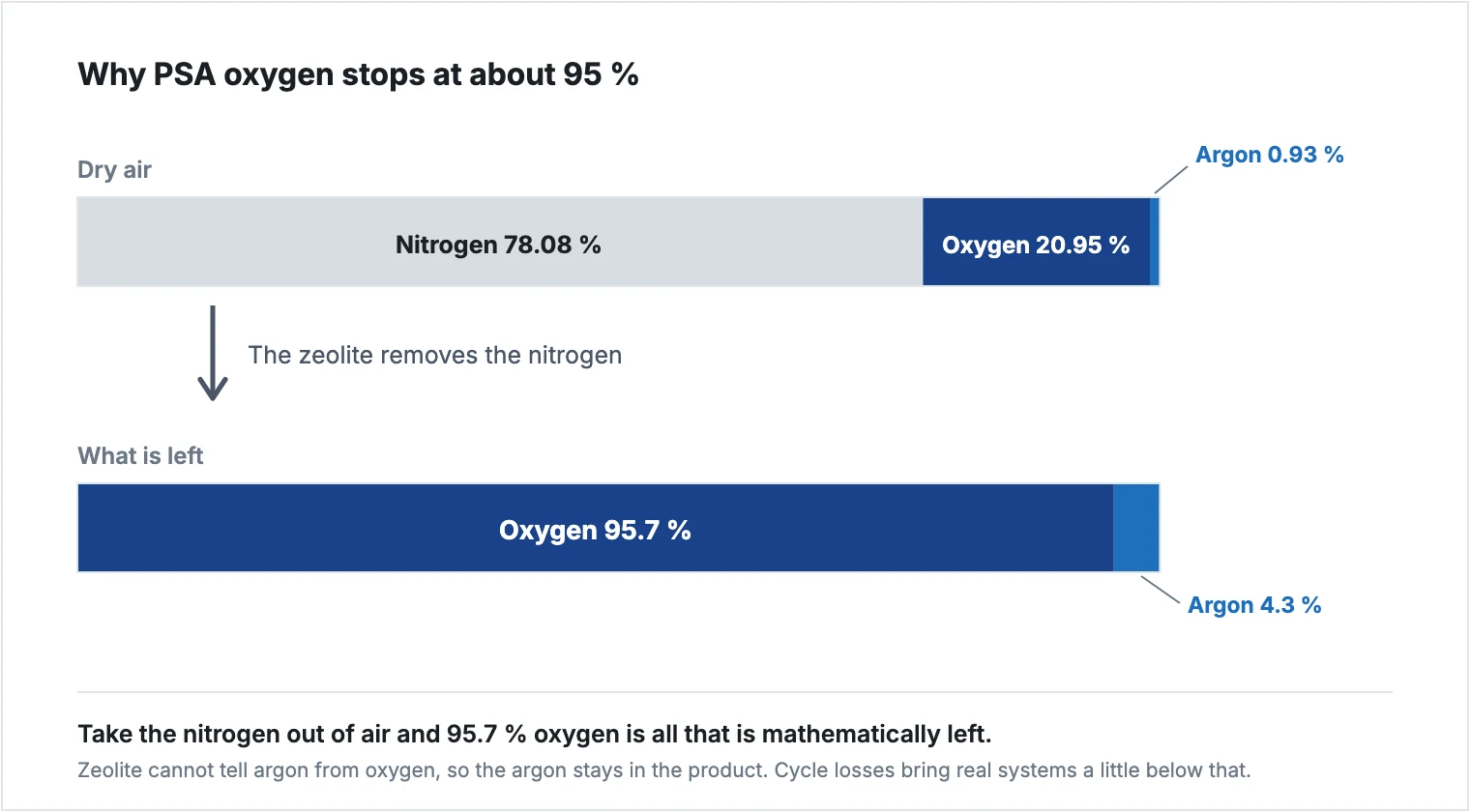
Zeolite cannot tell argon from oxygen, so the argon in the air stays in the product. Remove all the nitrogen and 20.95 parts oxygen and 0.93 parts argon remain, which caps the purity at 95.7 %.
Argon makes up just under 1 % of air. It is a single atom, close to an oxygen molecule in size and with no quadrupole moment at all, which means the zeolite holds it about as loosely as it holds oxygen. Whatever the bed does to the oxygen, it does to the argon as well, so the argon travels with the product from the first cycle to the last.
The arithmetic follows from that. Air contains 78.08 % nitrogen, 20.95 % oxygen and 0.93 % argon. Take the nitrogen out completely and 21.88 parts are left, of which 20.95 are oxygen. That is 95.7 %, and no amount of engineering moves it, because it is a property of the air going in rather than of the machine doing the separating.
Real installations stay below that figure. Cycle losses, residual nitrogen and the purge all cost a little, which is why single-stage PSA oxygen generators are specified at 90 % to 95 % and not at the theoretical ceiling.
At 93 % the remaining 7 % is two gases, not one. Roughly 4 % is argon, which follows from the air and stays almost constant whatever the machine does, and the remaining 3 % or so is nitrogen the cycle has not removed. The purity setting works on the nitrogen share; the argon comes in with the oxygen and stays in proportion to it. If your process is sensitive to nitrogen specifically, as ozone generation is, that split matters more than the headline purity, and it is worth stating in the enquiry. Any supplier promising 99 % from a single-stage PSA machine is either describing a different process or describing it incorrectly.
Getting past the argon takes a second separation stage on a carbon-based adsorbent, which raises purity to roughly 99 %, or cryogenic air separation, which removes argon as a product in its own right. Both belong to a different class of plant. For the great majority of industrial processes the question does not arise, because those processes are specified against what the oxygen has to do, and that sits inside the 90 % to 95 % band.
How Much Oxygen PSA Recovers from Air
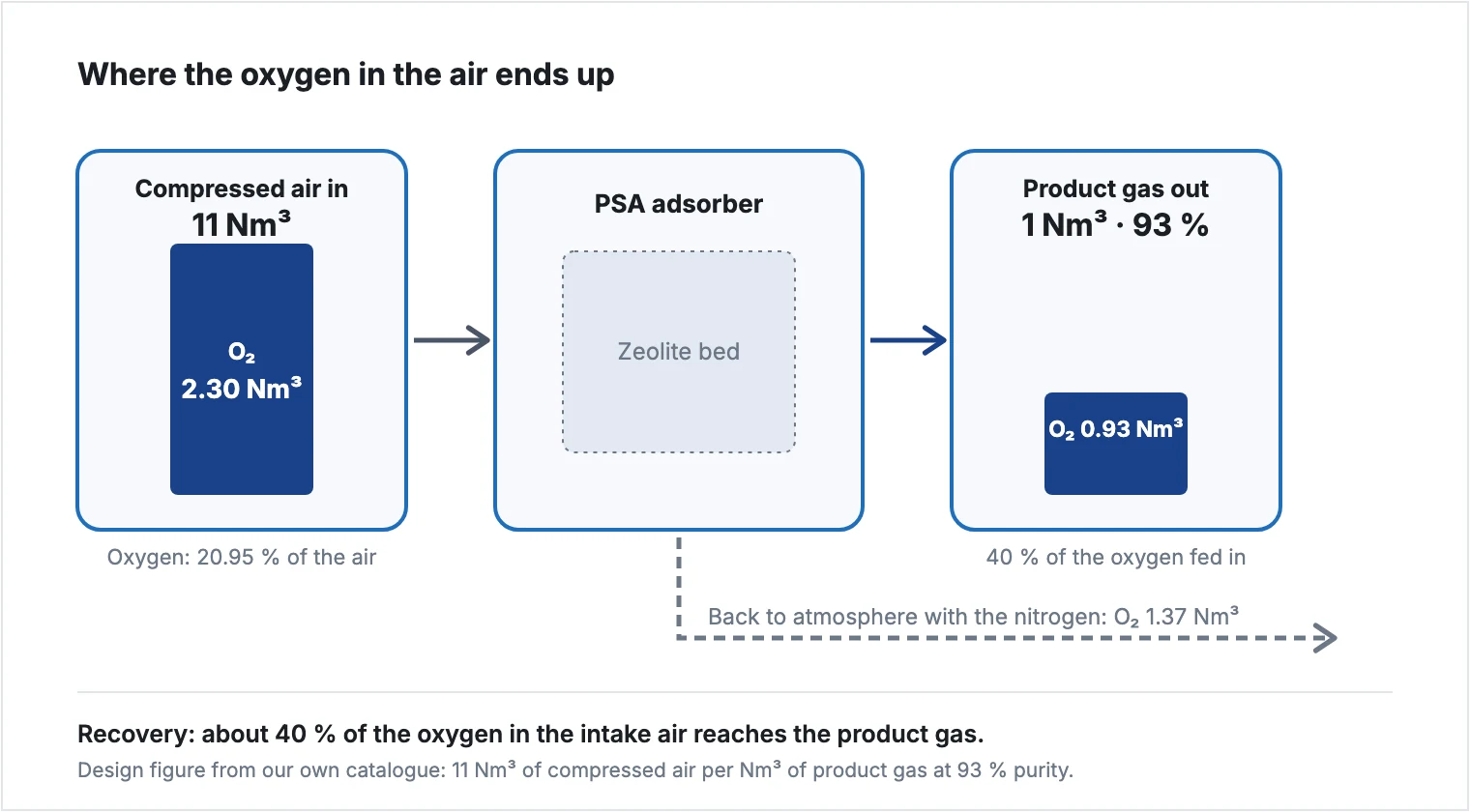
Our catalogue lists about 11 Nm³ of compressed air for every 1 Nm³ of product gas at 93 % purity, which means roughly 40 % of the oxygen in the intake air ends up in the product. That ratio of 11 is a design figure we apply across all eighteen model sizes, and it is quoted for one operating point: 93 % purity, 7 bar gauge inlet pressure, 20 °C.
The arithmetic is quick. Those 11 Nm³ of air contain 11 × 20.95 %, or 2.30 Nm³ of oxygen. One cubic metre of product gas at 93 % contains 0.93 Nm³ of oxygen. Divide the second by the first and the recovery is just over 40 %.
Two things are worth saying plainly about that number, because they decide whether you can use it. It is an engineering design figure, not a measured average across installed plants, so treat it as the value the plant is laid out to, not as a guaranteed consumption. And it belongs to one purity. Run the same machine at a higher grade and it delivers less oxygen while the compressor in front of it stays the same size, so the air per cubic metre of product gas goes up and the recovery goes down. That is the purge showing up in the figures: a higher grade needs a larger share of the product gas to clean the bed.
The oxygen that does not reach the product leaves the machine with the nitrogen and returns to the atmosphere. A process that extracted a higher share of the oxygen would need longer cycles, larger beds or a vacuum stage, each of which costs something else. How much oxygen a given size then delivers at each grade is a sizing question, covered further down.
For the operator, the useful number is not the recovery rate but the air factor behind it. Eleven cubic metres of compressed air per cubic metre of product gas is where the sizing of your compressor starts, with the air your dryer uses for its own regeneration on top, and compressed air is where the running cost of a PSA installation actually sits. Our separate article on generator energy consumption goes into what that means for a specific installation.
What Makes Up a Complete PSA Oxygen Plant
A complete PSA oxygen plant is the generator plus everything that feeds and buffers it, and the quality of the compressed air it receives determines how long the zeolite lasts. In a typical complete installation the generator is item 11 of 13.
Click any component to see what it does.

- Rotary screw compressor
- Water separator
- Wet air receiver
- Pre-filter (F-GW)
- Refrigerated or adsorption dryer
- Fine filter (F-FW)
- Super fine filter (F-SW)
- Activated carbon tower
- Dust filter
- Dry air receiver
- PSA oxygen generator
- Oxygen receiver
- Flow and pressure regulator with oxygen filter
Ten of those thirteen items sit upstream of the generator, and all of them do one job: deliver air that is dry, oil-free and clean. That is where the answer to the question about sieve life lies. Zeolite is regenerated in every cycle and is not consumed by the process itself, so what ages it is what arrives with the air. Oil vapour coats it, water occupies its adsorption sites, and particles block them mechanically. A plant with properly specified air treatment keeps the same sieve fill far longer; a plant that saves money on filters pays for it later in sieve replacement. This is also why no manufacturer can quote a service life for a sieve fill without knowing what compressed air feeds it.
Inside the generator itself, the part to ask about alongside the sieve is the valve assembly. At one switch every 60 to 120 seconds the valves see a few hundred thousand operations a year.
If you want to see the same plant as a delivered package, our oxygen plant page covers it, and the oxygen generator overview covers the generators themselves.
PSA, VPSA and VSA Compared
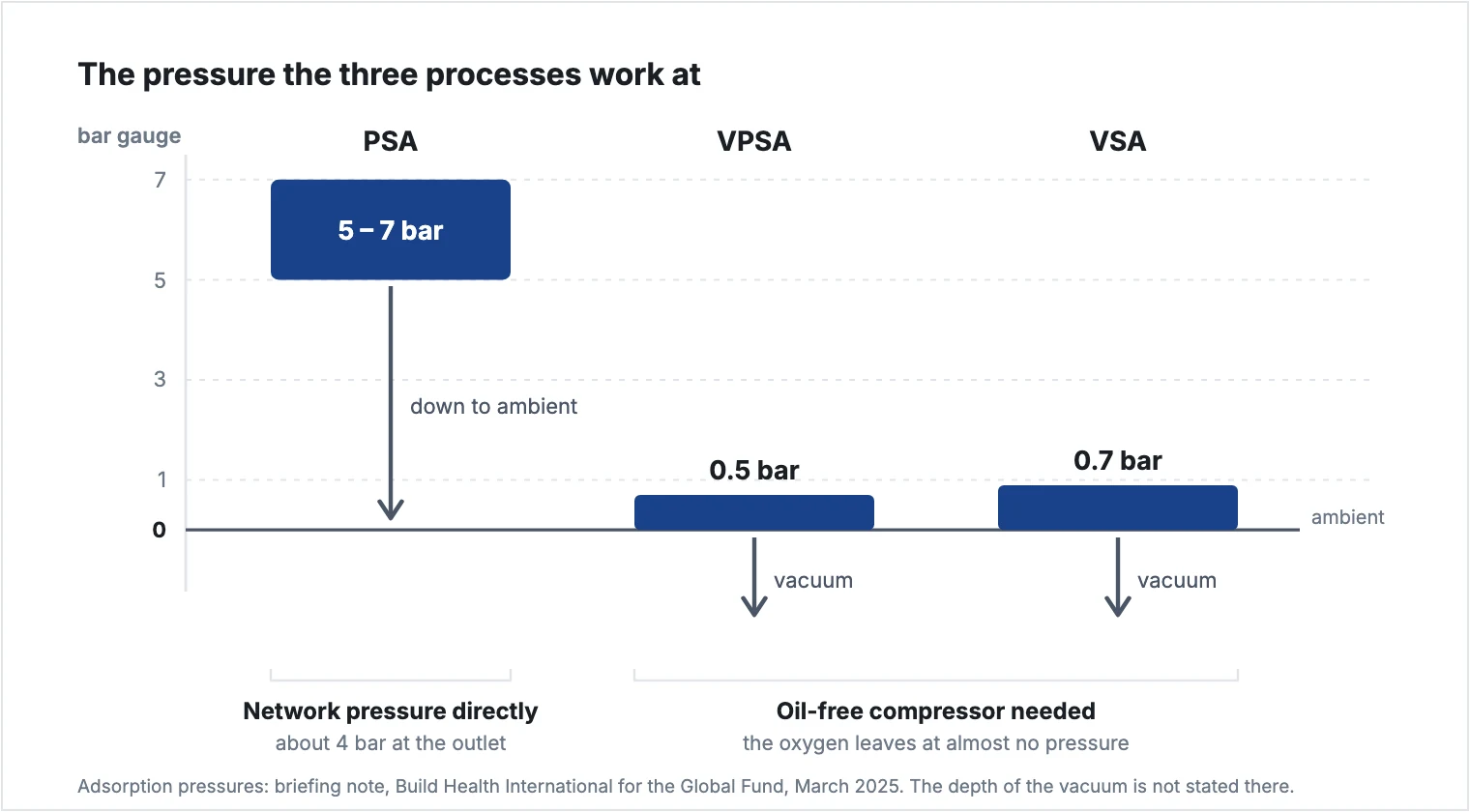
All three processes use zeolite and reach about 93 % oxygen; they differ in the pressure the bed works at, the machines that create it and whether the oxygen needs a compressor downstream. The figures below are taken from a briefing note prepared by Build Health International for the Global Fund in March 2025 and describe a typical industrial installation rather than one supplier’s range.
| PSA | VPSA | VSA | |
|---|---|---|---|
| Air supply | Screw compressor plus dryer | Rotary lobe blower | Rotary lobe blower, reversible |
| Bed pressure | 5 to 7 bar | About 0.5 bar gauge | About 0.7 bar gauge |
| Adsorber vessels | 2 | 2 | 1 |
| Nitrogen removal | By pressure alone, no extra machine | Vacuum pump | The same blower |
| Oxygen compression for the network | Not required, about 4 bar at the outlet | Scroll compressor required | Scroll compressor required |
| Purity | About 93 % | About 93 % | About 93 % |
The practical difference is where the energy goes and how many machines are involved. PSA compresses the air once, to a level high enough both to drive the separation and to feed a pipe network, which keeps the equipment count low and delivers usable pressure directly. The vacuum-based processes run the bed at close to atmospheric pressure and have a lower average power draw, but the oxygen leaves them at almost no pressure, so a separate oil-free compressor is needed before the gas can go anywhere.
That trade-off shifts with size. On small installations the saving from the vacuum process does not materialise, while the additional compressor adds cost and another component that can fail. On large ones the lower power draw begins to dominate. Where exactly that happens depends on your electricity price and running hours more than on the technology, which is why no single figure separates the two: a plant running three shifts crosses over at a smaller size than one running one. The source quoted above adds a recommendation worth repeating because it is so rarely made: the most important selection criterion is which technology can actually be serviced at your site.
How Oxygen Is Produced Industrially
Demand determines which process applies, and the order of magnitude is well established, although the boundaries are economic rather than physical and the processes overlap. Pressure swing adsorption covers demand up to roughly six or seven tonnes of product gas a day, which is where the largest single-stage machines sit. Vacuum-based adsorption reaches into that range from below and carries on well above it. From roughly 100 to 300 tonnes a day, cryogenic air separation becomes the economical route.
Cryogenic plants work on a different principle entirely. Air is cooled until it liquefies and is then distilled, with nitrogen, oxygen and argon boiling off at different temperatures. That is how industrial argon reaches the market, and it is also the answer to anyone needing oxygen above the adsorption ceiling: at that scale, the argon separates out as a product of its own.
The threshold between the two is economic, which is why the figures are given as a range. A cryogenic plant has a high capital cost and reaches its efficiency only at volume. An adsorption plant is comparatively simple, starts and stops without a long cool-down, and is competitive exactly where the demand is too small to keep a distillation column busy.
For most industrial sites the question answers itself. Our largest oxygen generator delivers 186 Nm³/h at 93 % purity, which is about 6.4 tonnes of product gas a day containing just under 6 tonnes of oxygen, so it sits at the top of the pressure swing range. Sites consuming more than that are generally large enough to be supplied by a dedicated plant or a pipeline.
That distinction between product gas and contained oxygen matters if you buy liquid oxygen today, because the two are counted differently. A tank invoice is in tonnes of almost pure oxygen; a generator is sized in cubic metres of product gas per hour at a stated purity. As a bridge between them: 100 tonnes of oxygen a year works out at roughly 9 Nm³/h of product gas at 93 % if the plant runs around the clock, and proportionally more if it only runs on shift. That single conversion is usually the fastest way to see which size range you are in before anyone quotes anything.
What Separates an Oxygen Concentrator from an Oxygen Generator
Both use the same pressure swing adsorption process: a concentrator is a small unit that supplies one user at low pressure; a generator is an industrial system that feeds a process or a pipe network at several bar. The words describe size and application; the technology underneath is identical.
A concentrator is built around a single user and delivers a few litres per minute at a pressure barely above ambient, enough to supply a mask or a cannula.
A generator serves a process. It delivers cubic metres per hour at several bar, feeds a pipe network or a piece of production equipment, and is installed as part of a plant with air treatment upstream and a receiver downstream. Its pressure is what allows the gas to travel through a network at all, and it is the reason a generator cannot simply be scaled down into a concentrator or the other way around.
In practice the terminology varies by market and by language. If you are looking for industrial gas supply, the term you want is generator or generation plant.
What to Pin Down Before You Ask for a Quote
Sizing a system takes seven figures: purity, flow as average and peak, pressure at the point of use, load profile and the compressed air already on site. Every one of them changes the result.
- Purity, set by what the process actually needs. A safety margin on paper becomes a larger machine in the plant room.
- Flow, stated as average consumption and as peak, because the two size different parts of the plant.
- Pressure at the point of use, not at the generator outlet, because you lose pressure across the distribution network.
- Load profile, meaning whether consumption is continuous, shift-based or irregular.
- Compressed air already on site, its capacity and its treatment, because an installed compressor may cover part of the demand.
- Site conditions: floor space, ambient temperature, ventilation and noise limits.
- What happens during a fault: buffer capacity, reserve supply, whether redundancy is required, and how the plant behaves while purity sits below your minimum. On our generators that behaviour is an option to be specified with the order: the controller raises an alarm and vents the off-spec gas through a solenoid valve, so it never reaches the outlet.
The load profile is the item most often reported as a single average. A PSA generator runs at its best under steady load, since the cycle is tuned to a particular throughput. Demand that swings between a quarter and full capacity is not a problem for the technology, but it has to be designed for, usually through a correctly sized oxygen receiver that lets the generator run evenly while the process draws irregularly. Tell your supplier what the curve looks like over a shift, and the buffer will be sized to it instead of being guessed at. For a first estimate: the standard oxygen receiver across our own range works out at roughly 25 to 50 litres per Nm³/h of rated flow at 93 %, with a median near 35, and a strongly swinging load needs more than that.
Specifying purity higher than the process needs carries a cost that is easy to miss. Across all eighteen of our model sizes, moving from 90 % to 95 % costs between 9 % and 29 % of throughput, with a median of about 14 %. The effect is largest on the small model sizes, where it runs closer to 20 % or more, and smallest on the largest ones. Since the compressor in front stays the same size, the same step also pushes up the air per cubic metre of product gas. In practice an unnecessarily high purity specification therefore pushes you into a larger machine for the same delivered volume.
Our OXYBERG® range covers 1.5 to 197.4 Nm³/h of product gas across five grades from 90 % to 95 %, the 197.4 Nm³/h at 90 %, and the oxygen generator pages list the individual model sizes with their flow and air demand. Send those seven points with your enquiry and you get a design back instead of an estimate.
What Purity Your Process Needs
The bands below are the ones we see most often in practice; treat them as a guide. Your own process decides the figure.
Wastewater treatment, including the ozone generation that often sits alongside it, and aquaculture generally work at 90 % to 92 %. Metals processing, glass production and oxidation processes typically sit at 92 % to 94 %. Hospital supply is usually specified at 93 %, for which the European Pharmacopoeia carries its own monograph, and whether a plant may feed a medical supply is decided by the rules in force where it stands. Processes that genuinely need the top of the range run at 94 % to 95 %, and above that the technology changes.
If you need to verify the delivered purity continuously, not only at commissioning, our article on oxygen purity measurement covers the instruments and where they belong in the plant.
FAQ: PSA Oxygen Generation
PSA stands for pressure swing adsorption, the process a PSA oxygen generator uses to produce oxygen from compressed air. It delivers 90 % to 95 % purity at several bar and runs continuously as long as it has air and power. The term describes the equipment; pressure swing adsorption describes the process inside it, and the same process in a small, low-pressure unit is called a concentrator.
Compressed air flows into a vessel filled with zeolite, which binds nitrogen far more strongly than oxygen, so the gas leaving the vessel is oxygen at 90 % to 95 %. Before the bed is saturated, the generator switches to a second vessel and vents the first to ambient pressure, which releases the nitrogen and regenerates the zeolite. Switching every 60 to 120 seconds turns that back-and-forth into a continuous flow of product gas.
VPSA stands for vacuum pressure swing adsorption. It uses the same zeolite and reaches the same purity of around 93 %, but it runs the sieve bed at roughly 0.5 bar gauge, against several bar in a PSA plant, and pulls the nitrogen out with a vacuum pump. The lower working pressure gives it a lower average power draw, at the cost of an additional oil-free compressor, because the oxygen leaves the plant at almost no pressure. The saving generally appears on large installations.
There is no catalogue figure for this, and any supplier quoting one without knowing your compressed air is guessing. Sieve life follows the air treatment upstream of the generator, not a running-hours counter, which is why the filter and dryer stages are specified as carefully as the generator itself. If you want a figure for your own case, ask for it against a stated compressed air class.
Yes, provided the installation is designed for it. The cycle itself is tuned to a throughput and runs most cleanly under steady demand, so varying consumption is handled through the oxygen receiver rather than by the generator chasing the process. A correctly sized buffer lets the generator run evenly while the application draws irregularly. This is a question for the sizing stage, and it is the reason your load profile belongs in the enquiry.
The oxygen receiver covers short interruptions, and anything beyond that is decided at the design stage. For continuous processes there are two common routes: keeping a cylinder bank or the existing liquid oxygen tank as a reserve for the first years, or splitting the demand across two smaller generators so that a fault costs capacity instead of supply. Which of the two fits depends on how long your process tolerates an interruption, and that is a figure worth bringing to the first conversation. On-site oxygen generation can significantly reduce dependence on external cylinder or liquid-oxygen deliveries. The required reserve/backup oxygen strategy must be defined according to the complete system design, applicable standards and local regulations.
If You Also Need Nitrogen
If you work with nitrogen as well, the same principle applies with a different adsorbent and a different limit. Our PSA nitrogen generators reach purities up to 99.999 %, because nitrogen has no equivalent of the argon ceiling. Which size fits your demand is something we work out against the seven figures above: send it to our engineering.