
Nitrogen Generators for Food Packaging
What decides shelf life is not the number on the gas cylinder but the oxygen left inside the finished pack. NITROBERG® produces the nitrogen for that pack from compressed air on your own site, at the purity you set, shift after shift. This page works through the purity and the flow a packaging line actually needs, so that a nitrogen generator for food packaging gets sized for your product rather than for a brochure.
What nitrogen does in food packaging
Modified atmosphere packaging replaces the air inside a pack with a defined gas. Nitrogen is the gas that does the displacing, because it is chemically inert and does not act on the product. Less oxygen in the headspace means slower oxidation of fats and pigments and slower growth of aerobic spoilage organisms, which buys shelf life without adding anything to the recipe. On crisps, baked goods and other crush-sensitive products the gas does a second job at the same time: the cushion holds the pack in shape so the contents arrive intact.
The gas gets in one of two ways. Most lines flush the pack before sealing, with nozzles blowing nitrogen through the headspace on a form-fill-seal or tray-sealing machine while the line keeps running. Where the residual oxygen target is tighter, the pack is evacuated first and then flooded, which reaches lower values but costs cycle time. Either way, what leaves the generator and what ends up in the pack are two different numbers, and only one of them shows up in a complaint.
A PSA generator makes the gas by passing compressed air through carbon molecular sieve, which takes up oxygen and moisture far faster than nitrogen, with one bed regenerating while the other produces. The PSA nitrogen generator page covers the process itself. This page stays with the packaging step; nitrogen used elsewhere in a food plant, for tank blanketing or product transfer, is covered under nitrogen in food and beverage production.
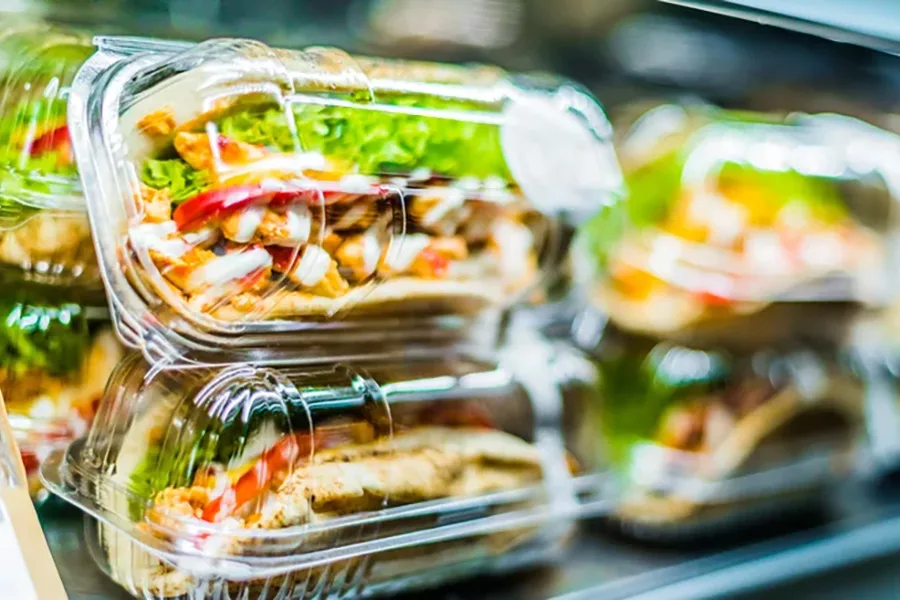
Residual oxygen decides shelf life, not gas purity alone
Purity at the generator sets a floor. At 99.5 % the gas still carries 5,000 ppm of oxygen, which is 0.5 %. At 99.9 % that drops to 1,000 ppm, or 0.1 %. Your pack cannot go below the floor the gas gives it, but it rarely reaches it either, because three other things sit between the generator and the seal.
Gas purity at the generator
This is the floor and nothing more. Above the MAP band it keeps falling on paper while the pack stops noticing, which is the single most useful thing to know before specifying a machine.
Purge time and nozzle geometry
How completely the air is displaced before the seal closes. On a fast line this is usually the largest term in the equation, and it is a machine setting rather than a gas specification.
Machine principle
Flushing during the running cycle leaves more oxygen behind than evacuating and flooding. The choice is made when the packaging machine is bought, long before anyone looks at gas.
Seal integrity
A channel in the seam lets air back in over days. Perfect gas and a poor seal give you a pack that fails at the end of its stated shelf life rather than at the start.
So the useful order is the reverse of the usual one. Fix the residual oxygen your product needs, check what your machine and your seal can hold, and only then decide which purity has to come out of the generator.
Which nitrogen purity a packaging line actually needs
In practice, food packaging runs between 99.5 % and 99.9 %. Below that the gas itself starts to limit what the pack can reach. Above it, the limit moves to the machine, and the extra purity is paid for without arriving anywhere.
| Purity | Residual oxygen in the gas | What it means for a pack | Air factor |
|---|---|---|---|
| 99 % | 10,000 ppm | 1.0 % oxygen in the gas, enough for the gas itself to start setting the limit. | 2.6 |
| 99.5 % | 5,000 ppm | 0.5 % oxygen. The usual working point for flushed lines. | 2.9 |
| 99.9 % | 1,000 ppm | 0.1 % oxygen. Used where the target is tighter or the product is sensitive. | 3.4 |
| 99.99 % | 100 ppm | Below what a packaging machine normally holds. | 4.6 |
| 99.999 % | 10 ppm | Laboratory and electronics territory, not packaging. | 6.4 |
Confirm the grade against your own product specification and your measured pack values, because the target moves with fat content, water activity, packaging film and the shelf life you promise. Berg supplies 99.999 % where a process needs it. On a packaging line it usually will not show up in the pack, and it will show up on the electricity bill every hour the line runs.
What 99.5 % nitrogen saves you in compressed air
Every NITROBERG® PSA size consumes a defined amount of compressed air per cubic metre of nitrogen. That ratio, the air factor, depends only on the purity you set, and food packaging happens to sit at the cheap end of it.
Take a line that needs 80 Nm³/h. At 99.5 % it draws about 232 Nm³/h of compressed air. Specify 99.999 % for the same 80 Nm³/h and the demand rises to about 512 Nm³/h. That is more than twice the compressor, twice the electricity and twice the compressor room, for oxygen that the pack was never going to notice.
The point is that the factor runs every operating hour, not once at purchase. On a line working two shifts, compressed air is the larger part of the running cost, and it is fixed on the day the purity is written into the enquiry. Where the plant is supplied as a complete package, the automatic blending stage is laid out around exactly this working point, at an air factor of 2.9 at 99.5 %.
How much nitrogen your packaging line consumes
Start from the pack
Headspace volume multiplied by a purge factor gives the gas needed per pack. The purge factor depends on the machine principle and on how thoroughly the headspace is swept, so take it from your machine builder or from your own measurements rather than from a table.
Multiply by your line rate
Packs per minute times 60 gives Nm³/h. With more than one line, apply a realistic simultaneity factor. Adding the peaks of every line is the most common route to an oversized plant, because format changes and cleaning rarely happen at the same moment everywhere.
Set the purity from your residual oxygen specification
Not from the highest grade available. The table above is the starting point, your own pack measurements are the confirmation.
Check the compressed air
Flow times air factor gives the demand. Quality counts as much as quantity: oil carry-over and residual moisture shorten the life of the carbon molecular sieve, so an undersized dryer costs more over five years than a slightly undersized compressor. NITROBERG® expects compressed air to ISO 8573-1:2010 Class 1.4.1 at 7 bar(g).
Need sizing for your application?
Send us your consumption profile and operating data. Our engineering team will size the generator and confirm the configuration.
NITROBERG® nitrogen generators in the food packaging purity range
NITROBERG® covers 18 sizes in total, listed in full on the nitrogen generator overview. The sizes below are shown at the two grades that matter for packaging, with the compressed air each one needs at 99.5 %.
| Model | N₂ at 99.5 % | N₂ at 99.9 % | Compressed air at 99.5 % |
|---|---|---|---|
| NITROBERG® 500 | 6.2 Nm³/h | 4.1 Nm³/h | 18.0 Nm³/h |
| NITROBERG® 700 | 17.4 Nm³/h | 11.5 Nm³/h | 50.3 Nm³/h |
| NITROBERG® 900 | 38.2 Nm³/h | 25.3 Nm³/h | 110.8 Nm³/h |
| NITROBERG® 1100 | 68.2 Nm³/h | 45.1 Nm³/h | 197.8 Nm³/h |
| NITROBERG® 1200 | 84.3 Nm³/h | 55.8 Nm³/h | 244.5 Nm³/h |
| NITROBERG® 1300 | 119.0 Nm³/h | 78.7 Nm³/h | 345.2 Nm³/h |
| NITROBERG® 1500 | 233.1 Nm³/h | 154.2 Nm³/h | 676.0 Nm³/h |
| NITROBERG® 1700 | 335.7 Nm³/h | 222.0 Nm³/h | 973.5 Nm³/h |
A single line at 80 Nm³/h and 99.5 % lands between the 1100 and the 1200. A second line, a tighter oxygen target or a switch from flushing to evacuating moves you up. The range does not stop there and continues to 990.3 Nm³/h at this grade, which covers a plant with several halls rather than a single machine.
Where there is no suitable compressed air on site, the generator is planned as a complete plant rather than as one machine: compressor station, air treatment, buffer, generator and nitrogen storage, engineered as one chain from one source within the BERG Group. The nitrogen generation package covers the pre-assembled plug-and-play configurations from NITROBERG® 500 to 900; above those sizes the same chain is put together as a project. Applicable NITROBERG® pressure equipment is conformity assessed under PED 2014/68/EU within the certified scope. Engineering and manufacturing are Made in Germany.
What a nitrogen tank really costs a food packaging plant
A liquid nitrogen tank delivers purity and peak flow without argument. What it does not deliver is a cost that follows your output. Rental runs through the quiet weeks between campaigns, evaporation losses continue every night whether the line moves or not, supply contracts carry price escalation clauses, and the delivery schedule that decides when the tank is full is not yours. Cylinders avoid the rental but bring the change-over into the middle of a production run, and on a line that flushes continuously that happens more often than anyone plans for.
Generating on site swaps all of it for an investment and an electricity bill you can put into the cost per pack. Against liquid-gas supply, a Berg PSA generator typically pays for itself within two to three years, and the figure improves the closer your working purity sits to the bottom of the MAP band.
Purity you set, not the highest available
The generator runs at the grade your packs need. That one setting decides the size of the compressor behind it, which is where the running cost actually sits.
Standard wear parts, no lock-in
Filters and consumables are off-the-shelf items from the open market. There is no proprietary parts programme after the purchase, and it is worth asking every supplier you compare where their filters come from.
Designed and built in one place
Berg develops and manufactures the generators itself, so the specification, the drawings and the assembly sit with one team that can answer a question about your configuration.
Direct access to engineering
Sizing questions go to the engineers who design the plants, not to a call centre. Warranty runs three years as standard and up to five years with a service contract.
What a nitrogen generator needs on site
| Parameter | Value |
|---|---|
| Operating pressure | 10 bar |
| Compressed air inlet pressure | 7 bar(g) |
| Compressed air quality | ISO 8573-1:2010 Class 1.4.1 |
| Sound level | 55 to 78 dB(A) |
| Ambient temperature | +5 °C to +40 °C |
The compressed air quality is a requirement on your supply rather than a property of the generator, and it is the item most often underestimated. Oil and moisture reaching the sieve shorten its life, and the cost of that appears years later as falling output rather than as a fault.
A buffer vessel belongs in the plan even when the average demand looks comfortable. Packaging lines do not draw evenly: start-up after a clean, a format change and the first minutes of a run all pull harder than the average, and the buffer covers those peaks so the generator does not have to be sized for them. How much reserve supply you keep beyond that is part of your own continuity planning.
Built in Germany, serviced with standard spare parts
Berg develops and builds the generators in its own plant. Engineering and manufacturing are Made in Germany. That matters less as a label than as a practical fact: the drawings, the assembly and the people who sized your configuration sit in one place, so a technical question reaches somebody who can answer it rather than somebody who has to pass it on.
Once the plant runs, support comes through a worldwide service partner network with a direct line back to Germany. Wear parts are standard components you can buy on the open market, which keeps service open to competition for the whole life of the machine. Over ten years that difference usually outweighs the difference in purchase price, and it is the question worth asking every supplier before the order rather than after it.
FAQ: nitrogen in food packaging
Nitrogen is chemically inert and makes up roughly 78 % of the air around you. Inside a pack it works by displacing oxygen rather than by acting on the product, which is why modified atmosphere packaging uses it as the filler gas across so many product groups. What a generator adds is a purity you set rather than one you receive: the residual oxygen content is measured continuously and displayed, so a drift shows up as an alarm instead of showing up on a pallet of finished goods. Deciding whether a given gas specification suits a specific product stays part of your own food safety system, alongside the packaging film, the process and the machine.
In practice, between 99.5 % and 99.9 %. At 99.5 % the gas carries 5,000 ppm of residual oxygen, at 99.9 % it carries 1,000 ppm, and those two figures set the floor for what the pack can reach. Below 99.5 % the gas itself starts to set the limit. Above 99.9 % the limit has already moved to the packaging machine, so the extra purity costs compressed air without changing the pack. Take the grade from your own residual oxygen specification and your measured pack values.
There is no single figure, because it depends on headspace volume, purge factor and line rate rather than on the size of the machine. Multiply the headspace of one pack by the purge factor your machine needs, multiply that by packs per minute, and multiply by 60 for Nm³/h. The purge factor varies most between machines and is worth establishing on your own line before anyone quotes hardware. With several lines, apply a realistic simultaneity factor instead of adding every peak together.
Check the number before anyone quotes hardware. Multiply your nitrogen flow by the air factor for the purity you choose: 2.9 at 99.5 %, 3.4 at 99.9 %, 6.4 at 99.999 %. Food packaging sits at the low end of that scale, which is why a MAP installation needs less compressed air per cubic metre of nitrogen than almost any other application. Air quality matters as well as volume, because sieve life depends on it. NITROBERG® expects compressed air to ISO 8573-1:2010 Class 1.4.1.
The buffer vessel carries the line through short interruptions, which is one of the reasons it belongs in the plan rather than in the options list. Beyond that, how much reserve supply you hold is a continuity decision that depends on your product, your run lengths and what an interrupted batch costs you. It is worth settling at the design stage, when a larger buffer or a cylinder backup is still cheap to add.
Pack quality follows the residual oxygen in the finished pack, and that comes from purge, machine and seal at least as much as from the gas. A generator set to the grade your packs need produces the same result as delivered gas at the same specification. The difference is in how you know: purity is a setting you choose and monitor continuously rather than a number on a delivery note, so a deviation appears as an alarm at the line instead of appearing later in a shelf life test.
No. The wear parts are standard components rather than a proprietary programme, so filters and consumables can be sourced on the open market and service offers can be compared. Over the life of a machine that usually weighs more than the difference in purchase price. Warranty runs three years as standard and up to five years in combination with a service contract.
The generator measures nitrogen purity continuously with a zirconium analyser and shows the reading on the HMI, together with a trend display for the running process. Sensor values and operating hours go into long-term storage for later analysis, and alarms carry a time stamp with a full audit trail, so a deviation and the acknowledgment that followed it stay traceable long after the shift that produced them. That gives your quality records a measurement tied to the gas you actually produced, rather than a certificate that arrives with a delivery.